
Environmentally friendly efficiency in the brewing process
Pivovar Klášter replaces its steam supply
The company
The art of brewing has a long history in the community of Klášter Hradiště nad Jizerou. First documented records date back to the year 1570. Since 1894 Pivovar Klášter brews Czech style beer on the site of the former monastery of the Cistercians. Until today the brewery relies on traditional brewing methods. For example, it does not use pasteurisation in order to preserve an exceptionally full-bodied and natural flavour. The cool cellar vaults of the brewery at a depth of 18 metres provide ideal conditions for fermentation and maturation. Five different beer specialities are produced here - in total approximately 76,000 hl per year. Today, Pivovar Klášter is part of the Pivovary Lobkowicz brewery group.
The project
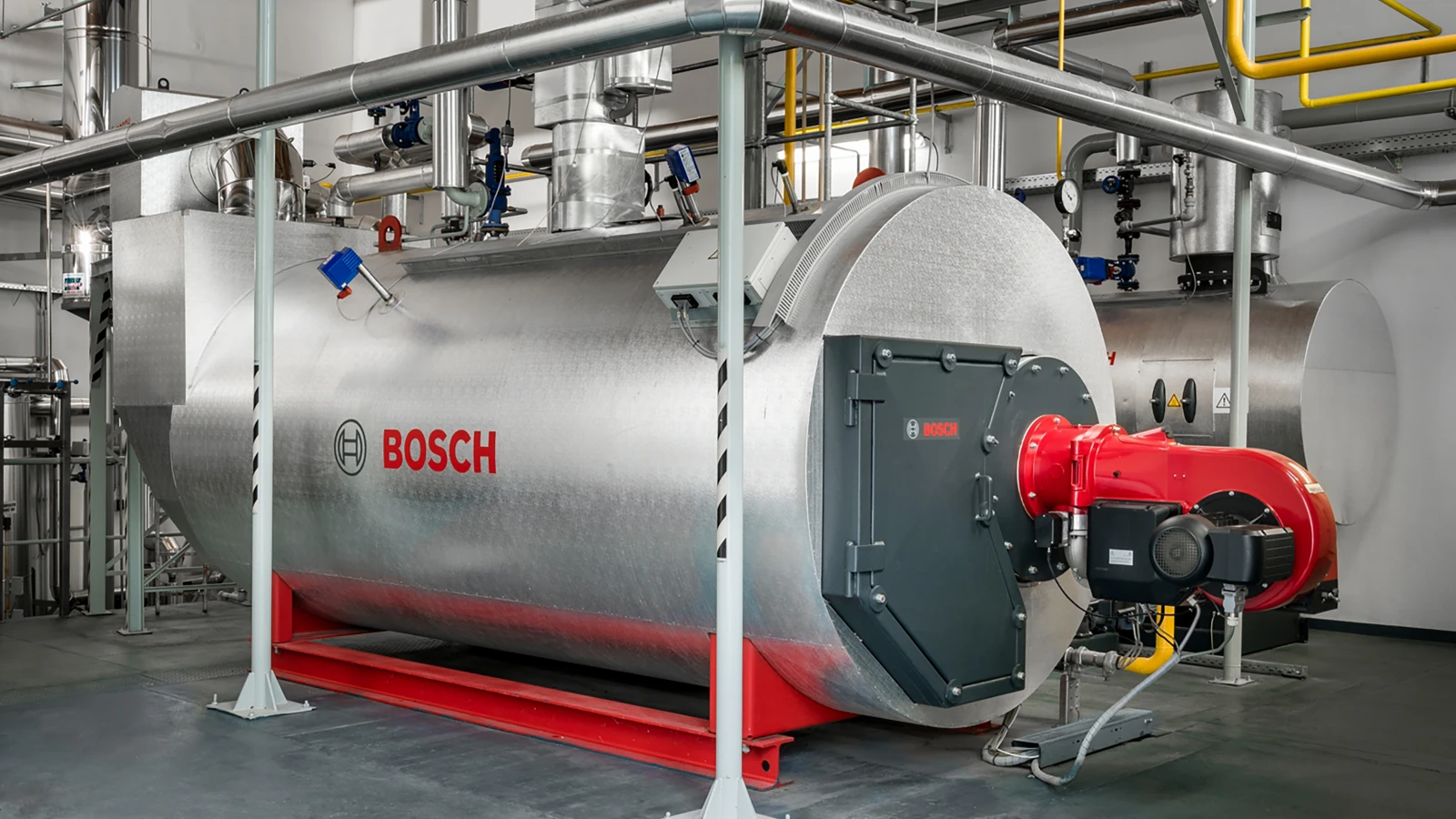
Besides the preservation of the traditional art of brewing the Pivovar Klášter brewery relies on environmentally friendly and resource-saving production. Beer production is an energy-intensive process. Mainly heat in the form of steam or hot water at different temperature levels is needed for processes like mashing, boiling and cleaning. The existing system for process heat supply was taken into operation over 30 years ago. In the course of the years the requirements to reliability of supply and energy efficiency increased. Thus, the brewery decided to completely renew the boiler house and replaced the existing system with a new steam boiler system type UL-S from Bosch. The result is impressive: The natural gas consumption has been reduced by around 47 m³ per hour. Approximately 75% of these savings are realised by the recovery of waste heat from flue gas. In total, the brewery saves up to 16 % on fuel costs with the new system.
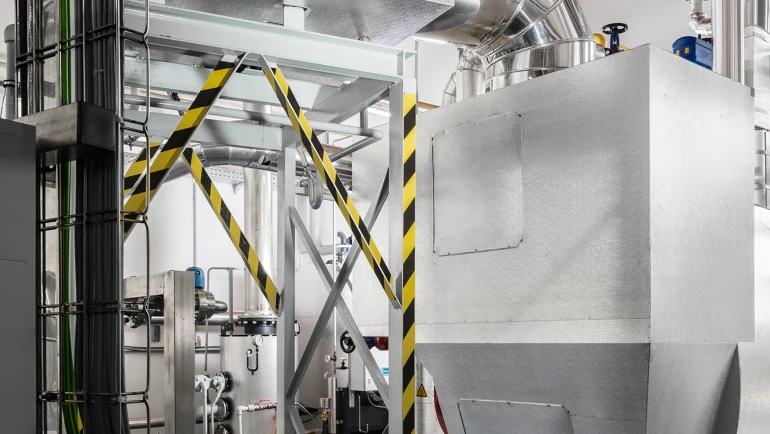
Perfectly matched components – boiler, economizer and condensing heat exchanger. The steam boiler UL-S, which proved itself in many thousands of projects, is the most compact boiler of its class and thus allowed an easy integration of a condensing heat exchanger.
The first flue gas heat exchanger (economizer) is used for preheating the feed water. Thus, less energy (fuel) is needed to heat up and evaporate water in the boiler. In the downstream heat exchanger the flue gas is additionally condensing. Due to the low temperature of this waste heat it is used for preheating the brewing water. It was thus possible to increase the primary energy efficiency to an impressive 97 %.
The shell boiler of the type UL-S can provide up to 4,000 kilogram of steam per hour. The natural gas firing with modulating control ensures an elastic operating behaviour. The burner capacity can be adjusted continuously to the actually needed steam demand. It is thus possible to reduce the number of burner starts and the related energy losses and wear. After downtimes the boiler can be started from the cold state very gently by using the intelligent automatic function SUC (start-up control). The SUC monitors and controls, for example, the water level during the heat-up phase and gradually opens the steam extraction valve in order to avoid thermal stress. Integrated protective functions further ensure low-stress operation after the start-up.
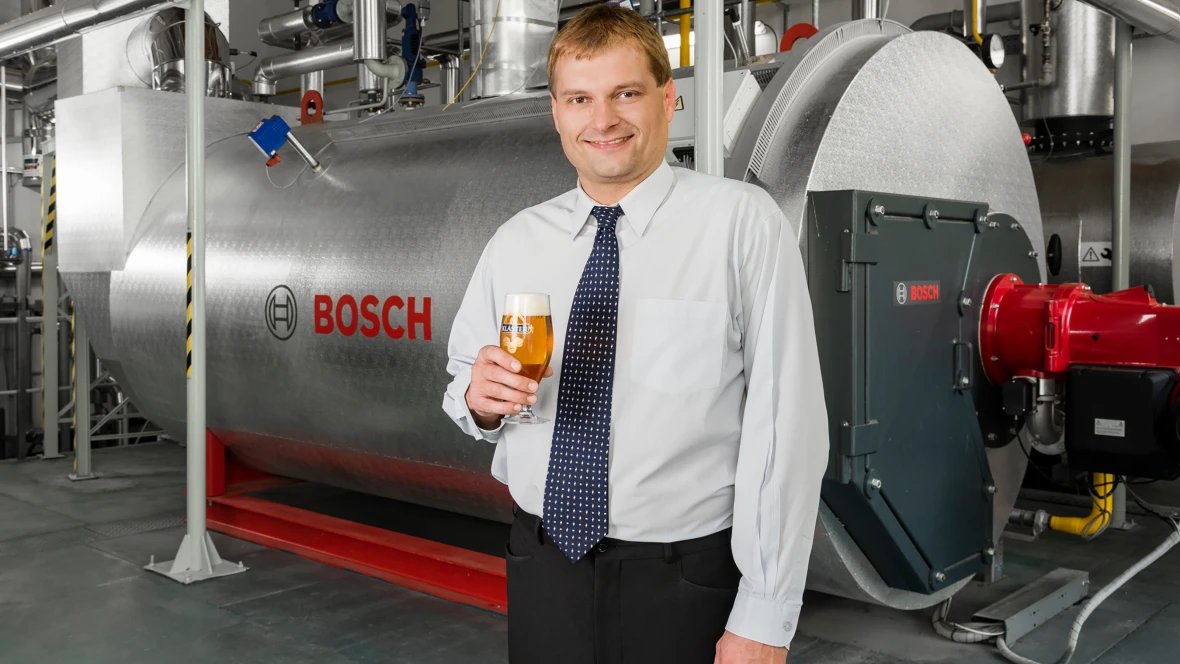
Director Zdenek Prokupek of Pivovar Klášter brewery relies on traditional brewing in combination with state-of-the-art engineering.
The boiler control BCO provides easy access to important operating data like fuel consumption, boiler and burner operating hours or the number of burner switches. Boiler attendant and the service expert from Bosch can thus derive further optimisation potential in the system. The BCO automatically controls desalting and blow-down. In comparison to a manual operation the demand-controlled process saves energy. Further advantages are an increased service life of the system and the avoidance of operating errors.
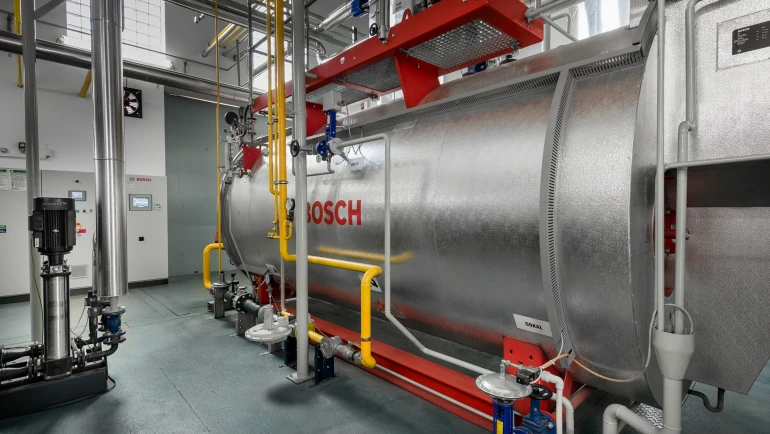
Demand-oriented and fully automated: Reduced obligation to supervise with cold start automatic as well as automatic desalting and blow-down for an efficient operation.
A continuously high steam quality is decisive for the complete brewing process. The thermal deaeration of the feed water used for steam generation is thereby a prerequisite. Feed water is heated up to 103 °C in order to eliminate corrosive substances like carbon dioxide and oxygen. This is followed by an adaptive and automatic dosing of corrosion inhibitors via the control of the deaeration module.
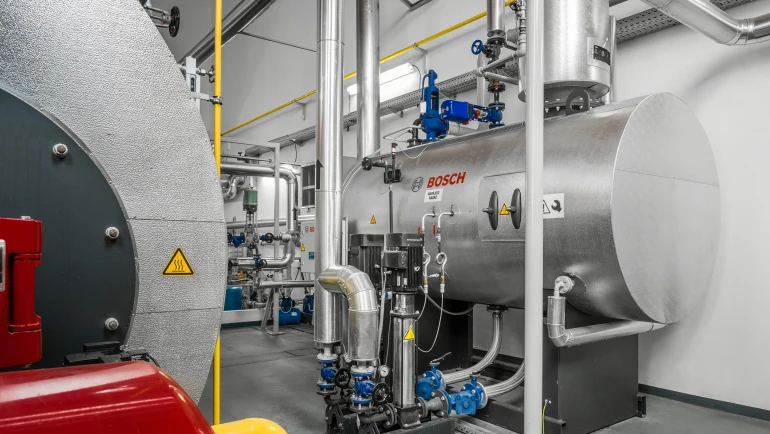
The deaeration module from Bosch protects boiler and components from corrosion and increases operating safety. The module is delivered pre-assembled from the factory and can be installed within shortest time.
The perfectly matched components from Bosch provide a reliable system and allowed a quick and smooth installation. Zdenek Prokupek, director of Pivovar Klášter, is pleased about the good result and the cooperation with Bosch: „With the new system we have managed to reduce our energy costs significantly and thanks to the high degree of automation we can now completely focus on beer brewing. Both the quality as well as the local service from Bosch in the Czech Republic have convinced us."
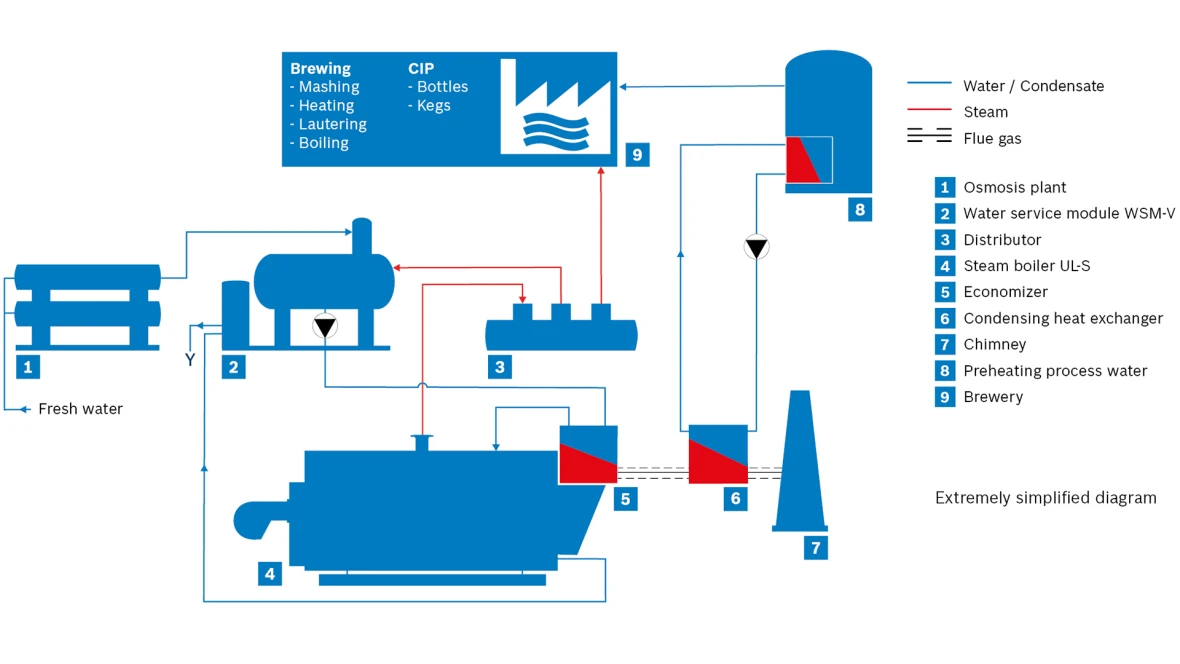
Simplified schematic diagram of the steam boiler plant at the Pivovar Klášter brewery.