
Generating 15 tons of steam efficiently
Rauch Fruchtsäfte uses waste heat for air preheating
The operator
The Rauch Group with headquarters in Rankweil, is Austria's largest producer of fruit juices and tea beverages. The company also enjoys a high degree of recognition internationally with its various brands such as Happy Day, Bravo and Rauch. In addition to the production of fruit juices and tea beverages at its location in Nüziders in the Vorarlberg region, the company also has a presence as a contract packer. Up to 125,000 l/h can be filled.
The project
Due to the continuous growth of the Rauch Group, an expansion of the production capacity at the Nüziders location became a necessity in 2013. As part of this expansion, the process steam supply was also extended with an energy-efficient Bosch steam boiler system. The UL-S shell boiler can produce up to 15,000 kg/h steam. The plant construction company, "Intemann GmbH" from Lauterach, carried out the installation of the new steam system. The company "ATP architekten ingenieure" from Innsbruck was responsible for the planning of the project.

Insights into our technology
Take a look behind the scenes. In this video, we show you our high-quality industrial boilers and system components up close.
Effective heat recovery
The steam boiler is equipped with an integrated economizer for using the heat potential of the hot flue gases. Thereby the feed water is heated from 103 °C up to 140 °C, before it is used for generating steam. This increases the efficiency of the steam boiler by approx. 6%. The fuel consumption at full load is reduced accordingly. The downstream flue gas heat exchanger cools the flue gas from 130 °C further down to 80 °C.
Air preheating increases system efficiency
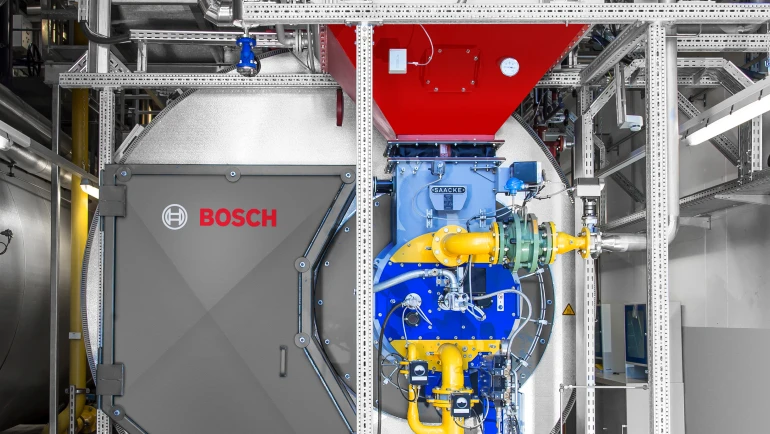
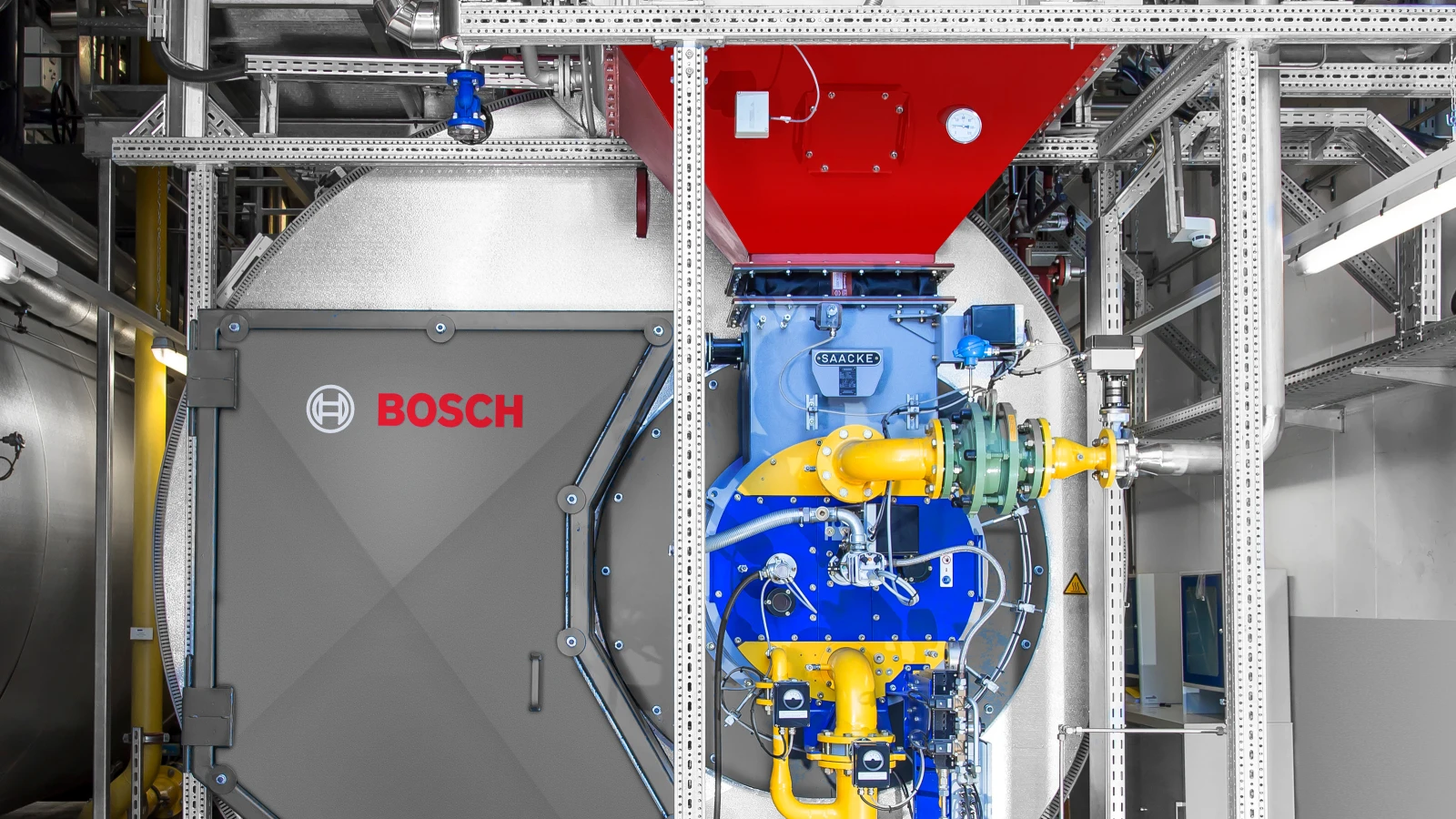
Energy-efficient Bosch steam boiler UL-S with air preheating system and twin-fuel firing system.
The residual heat of the flue gases is used to preheat the combustion air, since water heating is already supported by other measures. Feed water at 103 °C is removed from the system, and the heat is released to the combustion air via the heat exchanger on the air side. The 65 °C cold feed water is then reheated in the flue gas heat exchanger and fed back into the system. A three-way valve equalises the volume flows of the feed water supply.
Low servicing and maintenance expenditure as well as the low investment costs were crucial factors in the decision for a Bosch air preheating system. The chosen solution also increases the efficiency by 2%, thereby reducing the primary energy usage and protecting the environment at the same time.
State-of-the-art firing technology for the integration of a biogas plant
This advanced twin-fuel firing system burns biogas in mixed operation with natural gas. The biogas is generated from the solid remnants arising from the fruit juice production. The biogas is supplied in proportion to the biogas production rate. With maximum biogas use, less natural gas is needed.
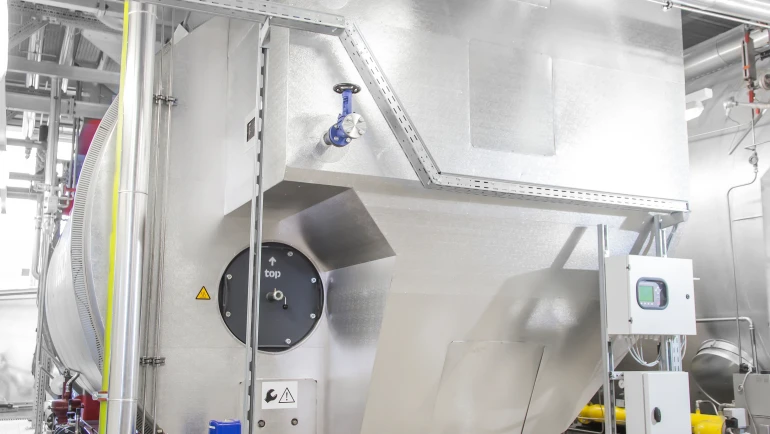
Effective use of waste heat with integrated economizer and flue gas heat exchanger.
A large control range of 1:7 and speed control ensure an energy optimized operation of the burner and fan. The modulating operation allows a seamless adaption to the current steam demand. Energy losses caused by frequent switching on and off of the burner can be avoided. The motor speed is adjusted flexibly to the actual burner output by means of the speed control. The result is reduced power consumption and noise-reduced operation.
O₂ control combined with a CO probe ensures an optimal fuel-air ratio. It continually records the oxygen level and the unburned components of the flue gas and controls the air supply accordingly. This increases the efficiency of the firing system and reduces the fuel demand. Variations in the gas quality can also be compensated.
Intelligent control and intuitive operation
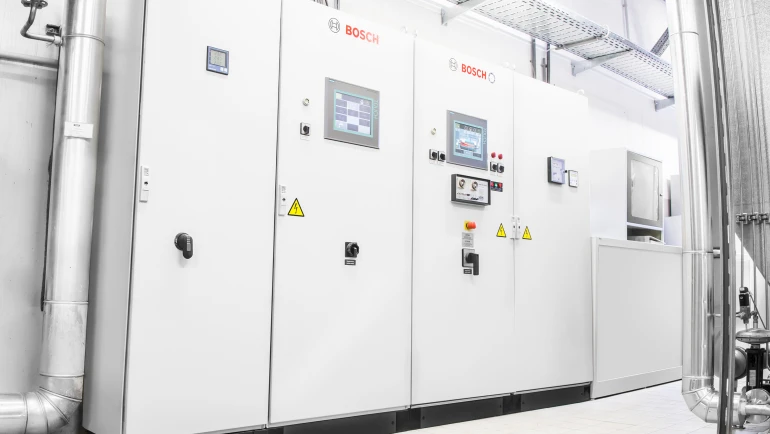
Bosch control technology ensures a high level of data transparency.
The boiler control BCO offers intuitive control and a completely transparent operation. The integrated Condition Monitoring software ensures consistently high efficiency and availability. It detects, for example, unfavourable start-up conditions or creates maintenance messages. Condition Monitoring also indicates possible energy savings, for example during blow-down and desalting. The sequence control in the management system SCO optimises service life by intelligently switching on and off the primary and follow-in boiler. Operating messages and up-to-date process data from the system are transmitted via an industrial Ethernet connection to the process control centre. A remote service connection provides quick support by the Bosch customer service.
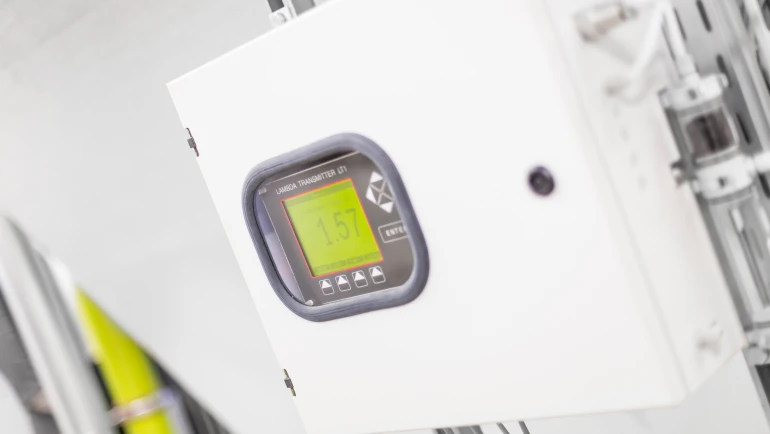
O₂ and CO controls achieve optimum combustion.
Another system component is the condensate monitoring for preventing the ingress of foreign substances. The condensate is continually checked for harmful substances such as grease or oil, which are safely discharged in the case of contamination. This prevents damages and safeguards a long service life.
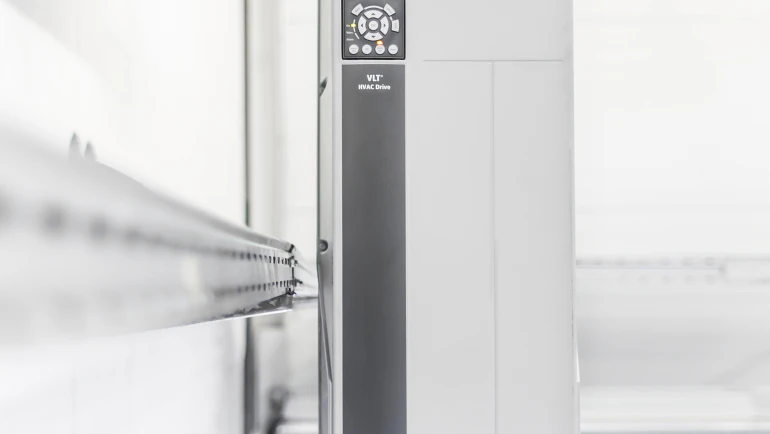
Speed control for low power consumption.
Automatic desalting and blow-down devices ensure optimum water quality in the boiler. The high-temperature blow-down water is collected in an expansion tank, where it is depressurised and cooled down to the permitted discharge temperature. The system meets the requirements for a 72-hour operation without permanent supervision.
Scope of delivery
- Bosch steam boiler UL-S with integrated economizer
- Air preheating system APH for additional efficiency increase
- Modulating twin-fuel firing system for operation with natural gas and biogas
- CO/O₂ control for optimised combustion
- Power-saving speed control
- Control systems BCO/SCO with Condition Monitoring and sequence control
- Condensate monitoring
- Automatic desalting and blow-down devices with expansion tank
The result
The new Bosch steam boiler system provides efficient and sustainable process steam supply at Rauch Fruchtsäfte in Nüziders. The chosen solution with its economizer and air preheating system significantly reduces the energy demand and CO2 emissions: air preheating alone saves up to 41,000 euros annually in fuel costs and reduces the CO2 emissions by approx. 175 tons per year, while the capital return is only about one year. The other system components, such as the state-of-the-art firing technology and the intelligent control systems, further increase the energy efficiency.
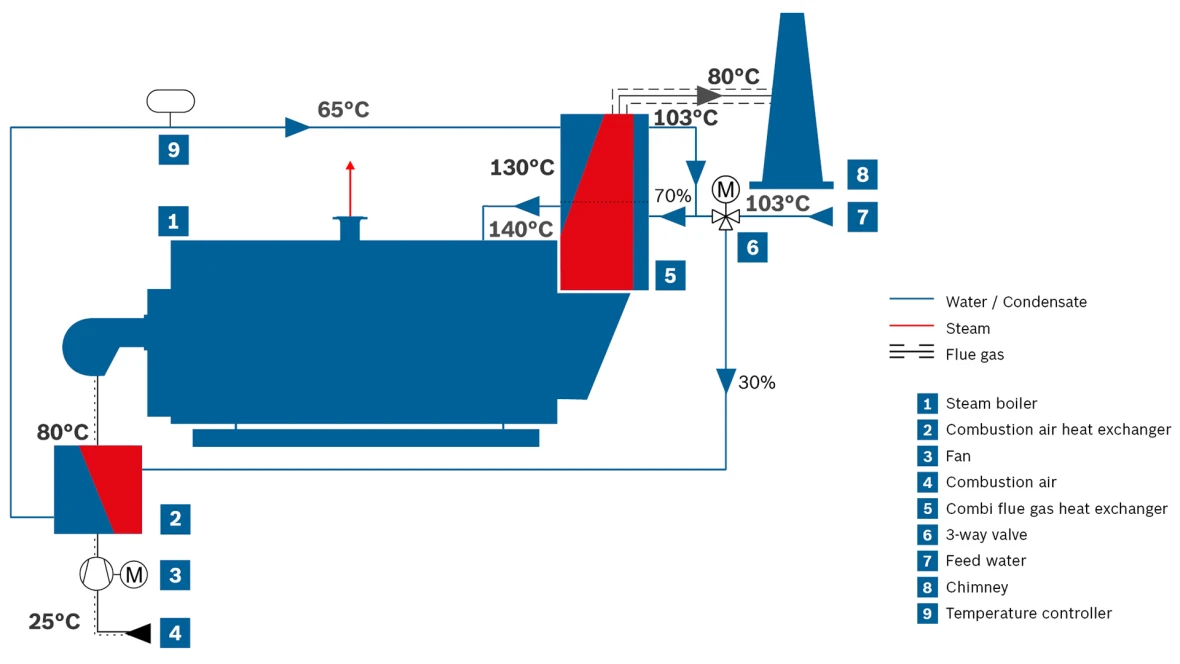
Simplified hydraulic diagram of the Bosch air preheating system at Rauch Fruchtsäfte.