
High-efficiency energy concept at Edeka Südwest Fleisch
The company
Edeka Südwest Fleisch GmbH, headquartered in Rheinstetten near Karlsruhe (Germany), employs around 700 workers to produce meat and meat products – precisely 375 tonnes per day. The highest possible quality and responsible behaviour when it comes to energy and the environment are paramount. The production involves numerous energy-intensive processes. Most of the steam and hot water is used for boiling and cooking meat products as well as for cleaning purposes. In addition, a large amount of electric power is required for operating the production plants and for cooling in the refrigerated warehouse. For ecological and economic reasons, Edeka Südwest Fleisch decided to invest in a highly-advanced energy concept.
The project
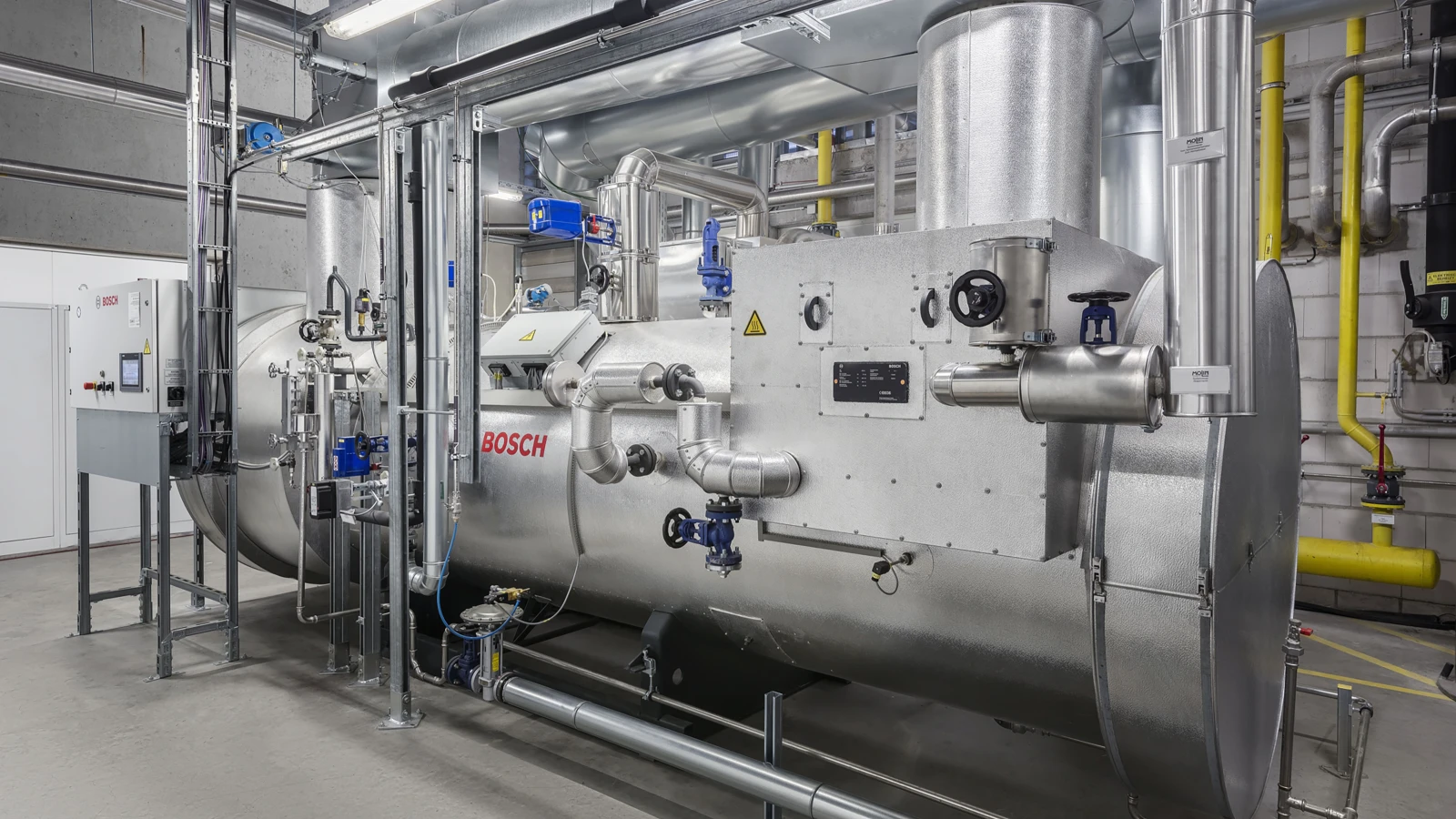
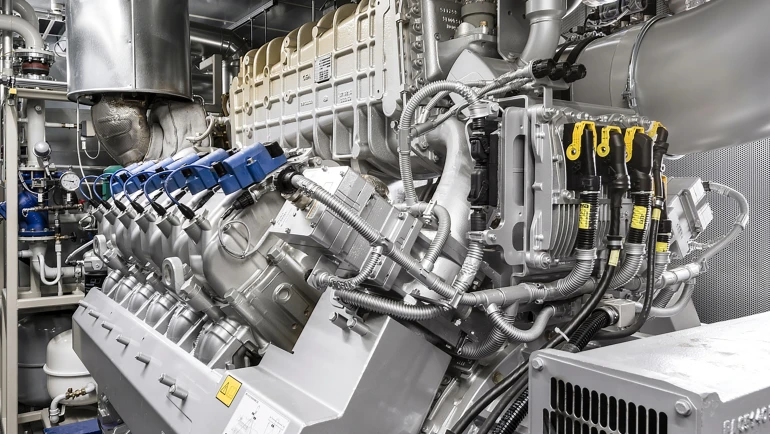
At the very heart of the energy supply is a CHP with a 2,000 PS 12-cylinder engine. Its waste heat supports the hot water generation and the heating network. This module delivers eleven million kilowatt hours per year – equivalent to the power consumed by some 2,750 households. The flue gas from the natural gas-powered CHP engine still contains valuable energy. To ensure highly-economical use of this energy, Edeka Südwest Fleisch decided for a Bosch heat recovery steam boiler (HRSB). The boiler can utilise almost eight tonnes of flue gas with temperatures of up to 550 °C. Unlike conventional heat exchangers that generate hot water, it converts the waste heat into saturated steam at high temperatures of over 180 °C. This makes the used waste heat much more valuable. Afterwards the flue gas is cooled down even further in a downstream flue gas heat exchanger for maximum waste heat utilisation.
To minimise operating effort, the heat recovery steam boiler is equipped with various automation devices, such as automatic desalting and blow-down functions, and also feed water regulation modules to achieve a constant water level in the boiler. These devices ensure a more smooth operation with lower material stress, while increasing efficiency at the same time. The integrated BCO boiler control records, for example, the flue gas temperature upstream and downstream of the boiler, provides data in case of inefficient operation and generates maintenance reports. If steam is not needed, the heat recovery steam boiler can be circumvented by the flue gas bypass on the flue gas side. This ensures continuous operation of the CHP, regardless of the steam demand. The BCO controls the flue gas flaps via an automated process.
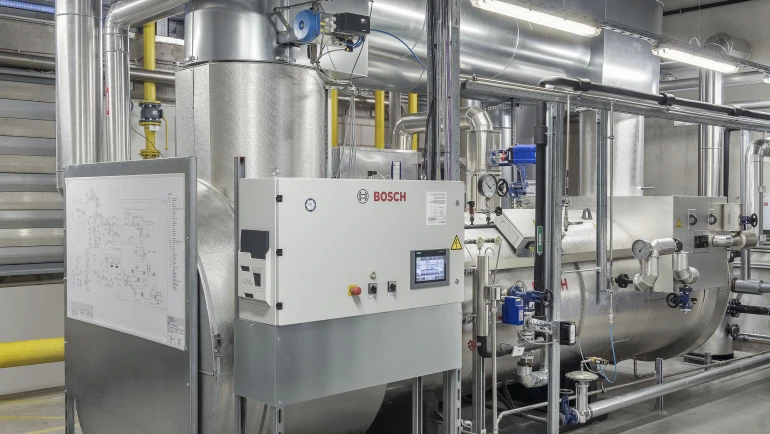
Highly efficient and resource-saving: The HRSB uses the waste heat from the CHP engine to generate steam.
The HRSB covers the base load with nearly 900 kg/h of steam. The existing two UL-S boilers are used for peak loads, they can deliver up to 5,000 kg/h of steam each. The modular, compact design allows the heat recovery steam boiler to be effectively integrated into the steam network. The existing water service module now supplies all three boilers with thermally deaerated feed water. All operating data, including for all boilers and modules, are transmitted to the company's central control via a Profibus connection.
The complete system, involving the installation of around seven kilometres of piping and power lines, was realised by the plant engineering company Jörke & Weber Haustechnik. The company also installed the complex expansion to the refrigeration system by an absorption refrigerator, which converts waste heat into cold air. Thanks to optimum interaction between all energy generators, Edeka Südwest Fleisch was able to cut its energy costs by some 15 %. The high investment will have been returned in approximately four years. In addition, the environment is being relieved of roughly 900 tonnes of CO2 per year.