
Sustainable potato processing at Henglein
Bosch enables CO2 reduction in the process heat
Efficient energy generation is a major issue in industrial production. Along with electricity, the demand for steam and heat is enormous for many processes. Food producer Hans Henglein und Sohn GmbH in the Franconian village of Wassermungenau, Germany, shows how wise it is to invest in sustainable process heat and benefit from attractive subsidies at the same time.
30% subsidy for Henglein
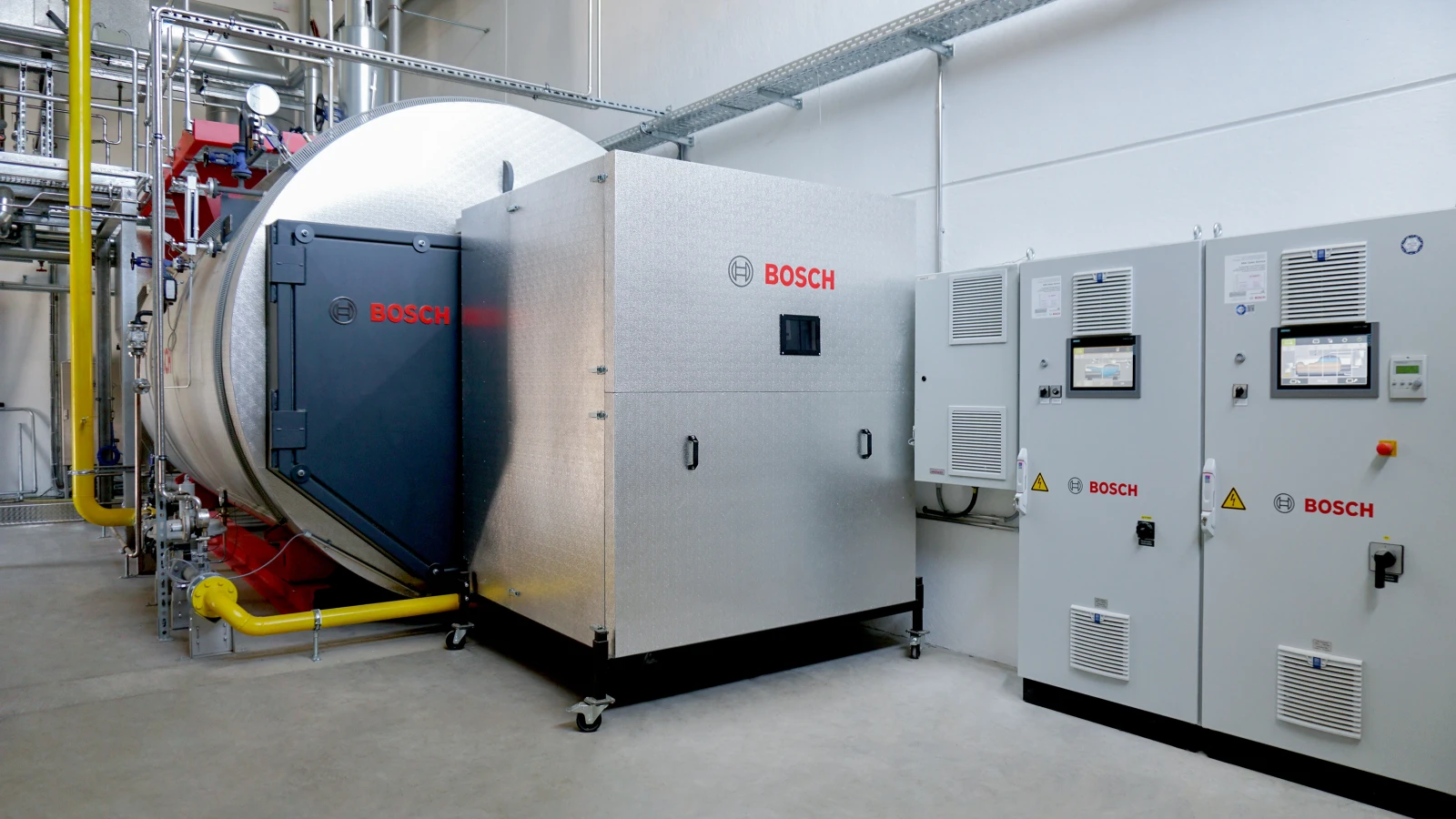
The traditional Franconian potato dumpling made from predominantly locally farmed potatoes is Henglein's best-known product. Alongside the traditional potato assortment, the company has focused meanwhile on fresh dough products. The total production volume at the Wassermungenau location is around 100,000 tonnes a year. The original process heating plant had grown steadily since the site was founded, consisting until recently of four Loos industrial steam boilers. With up to 31 years of operation and for economic reasons, however, the boilers no longer met Henglein's environmental and efficiency requirements. This is now fulfilled by a new UL-S steam boiler from Bosch, which is particularly impressive for its efficiency. In addition to an electricity saving of around 50% and a NOx reduction of 35%, fuel and CO2 emissions have been reduced by around 15%. That represents considerable added value for the climate and environment and it meets the eligibility criteria for funding through the state development bank KfW (as of 2019). Towards all capital expenditure on efficiency-enhancing and CO2-reducing components, the company received subsidies amounting to 30%.
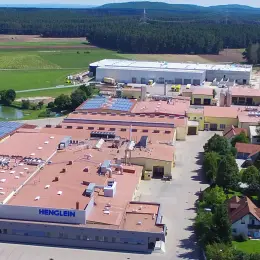
As processors of agricultural products, we have a particular obligation to ensure sustainability in our production
Concept for reducing CO2
This was made possible by clever conceptual design and planning by Henglein and its efficiency consultant, the local engineering office Tobias Lüpfert and Bosch Industriekessel. Dr. Alexander Vollet, who led the project as sales engineer at Bosch, summarised: “With our technical documentation, customer-tailored design and 3D symbols, we managed to reduce planning effort and interfaces and achieve the specified efficiency”. The latter was also the basis for the awarding of subsidies. Just 17 km away from the installation site, Bosch manufactured the steam boiler from the UL-S product line at its main factory in Gunzenhausen-Schlungenhof. The design has been developed from the ground up for energy efficiency, with the generously sized combustion chamber and the optimum boiler and burner combination enabling particularly low emissions. The boiler also performs well below current and even future legal limits for NOx values in Germany. Further benefits are offered by the broad control range of the firing system. Instead of achieving the actual power demand by turning the burner on and off, the burner modulates down to the real-time demand. This avoids energy-intensive pre-purging and, therefore, unnecessary heat losses. Together with the installed oxygen sensor, it is possible to achieve an optimum combustion air ratio, which reduces the fuel supply even further.
Maximum efficiency level >100 %
Substantial added value in carbon emissions reduction is provided by flue gas heat exchangers, which these days should belong to a boiler's standard equipment today. At Henglein, two of these modules were installed. First, the integrated economiser uses the hot flue gas to heat the feed water. The residual heat in the flue gas enters the customer-tailored condensing heat exchanger where it is used to preheat the make-up water. The flue gas temperature is ultimately reduced to a very low 55 °C. This saves tonnes of CO2 and a considerable amount of fuel. While the efficiency of the old boiler plant without economiser was around 85%, the new steam boiler achieves over 100% thanks to its efficiency and condensing technology. Bosch also supplied modules for energy recovery from the desalting water and exhaust vapours (degassing process). This leads to a further fuel reduction and lower emissions.
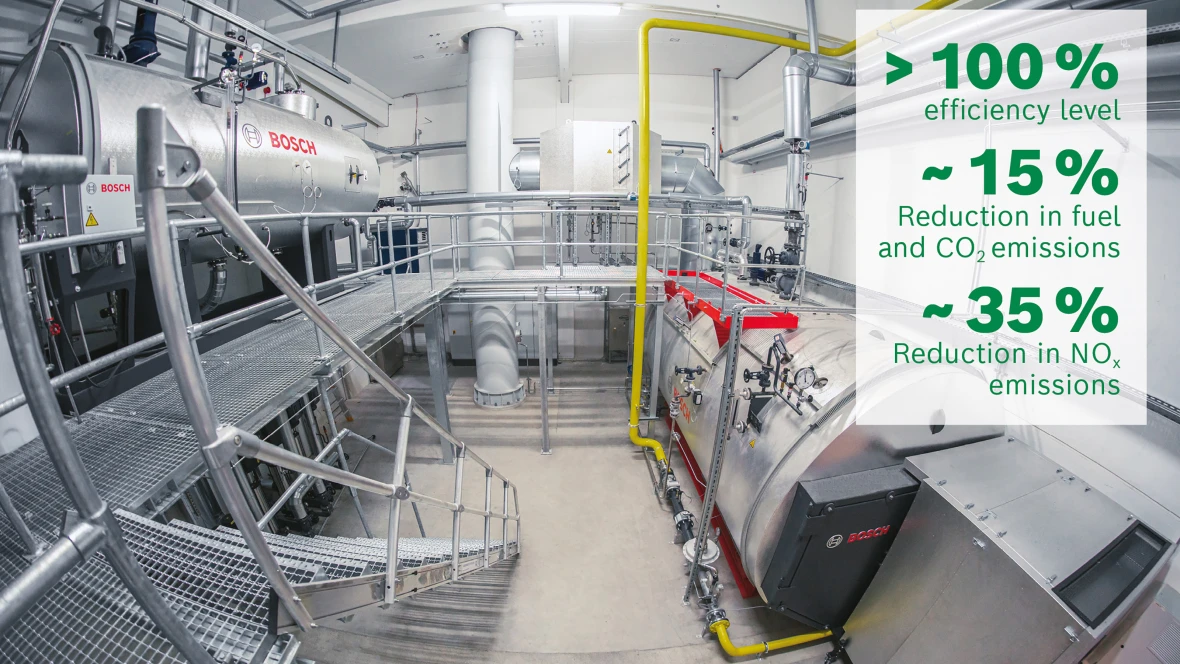
Tailored boiler system from Bosch for process heat – for greater efficiency, reliability, and durability.
Intelligent assistance in process heat
The integration of a smart efficiency and availability analysis for boiler operation was also considered – meaning an Industry 4.0 application for process heat. The MEC Optimize digital efficiency assistant from Bosch collects and interprets the operating data, evaluates the service life of components based on the operating mode and analyses water values. The digital assistant immediately detects energy losses and thus higher emissions as well as critical states. Furthermore, MEC Optimize proactively offers the operator recommendations for action. This makes things considerably easier for Henglein employees, whether they want to plan maintenance, rectify faults or optimise the efficiency during operation. Another positive aspect is the simple system integration into Henglein's automation system. MEC Optimize is compatible with all common protocols. The operating instructions and system-specific documentation are also digitally integrated and can be looked up at any time. In addition to transmitting data and analyses to the control centre, MEC Optimize also allows its user interface to be displayed on a tablet, mobile phone or PC irrespective of the location. It is even possible to activate e-mail or SMS alarm notifications in the system.
Today, intelligent automation is part of a well-functioning and energy-efficient process heat supply. At Henglein, all functions, such as water level control in the boiler, on-demand desalting or control of the thermal degassing module, are now fully automated by the new Bosch controls. The data stored there locally are also the basis for the digital efficiency assistant. Further components, including the system for feed water degassing, were also part of the delivered equipment and arrived at the installation site – as with all other Bosch components – assembled and insulated. Without any interruption of production processes, the entire equipment was ultimately installed and piped in by plant construction company Petry from Neumarkt.
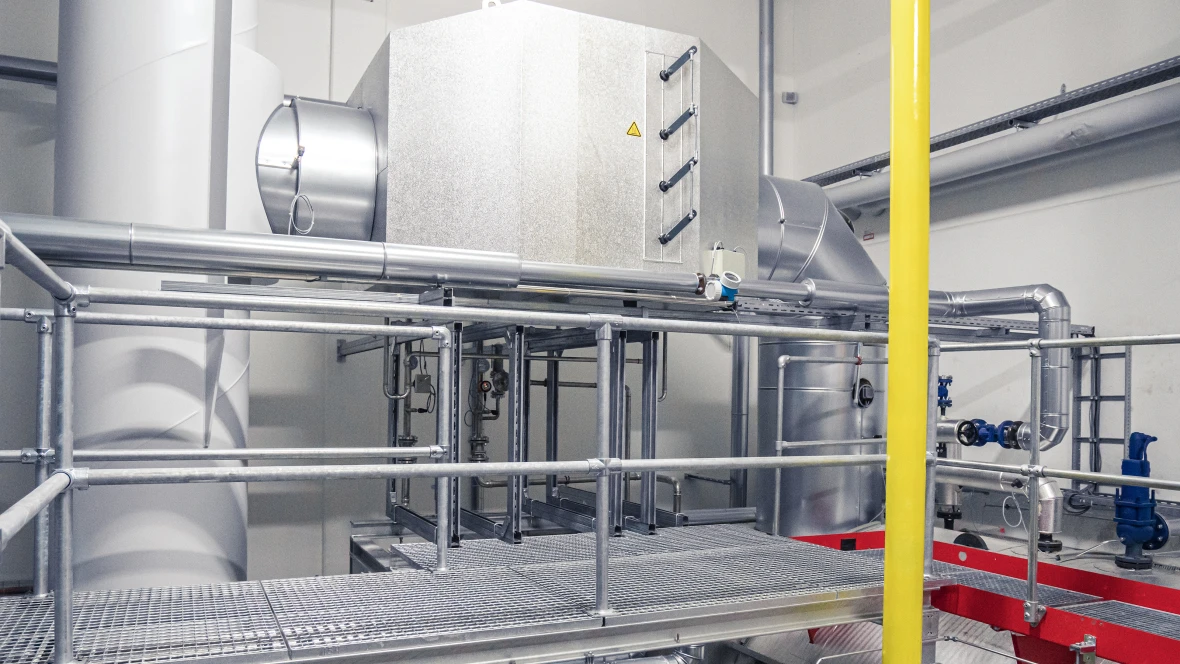
In conjunction with condensing technology, it is possible to maximise efficiency and save tonnes of CO2.
Summary
With efficiency and intelligence, the new Bosch boiler system at Henglein optimises processes and helps to reduce the carbon footprint significantly. This was even acknowledged by state development bank KfW, which awarded a subsidy of around 30% towards the fitted efficiency components including assembly costs. “For us, the topic of environmental friendliness plays a key role, which we are continuously improving with energy-efficient installations and transparency of all energy flows,” says Norbert Henglein. In matters of process heat, Bosch Industriekessel has made carbon emissions reduction technically viable.