
Efficient steam for preserved food
Modular Bosch technology at Valenzi
The operator
Founded in 1954, Valenzi GmbH & Co.KG is a leading manufacturer of preserved wild berries. A multinational family business, it produces and processes approximately 4 million kg of mushrooms, 2 million kg of fruit and 700,000 kg of soup ingredients every year. Valenzi employs approximately 100 people at its site in the town of Suderburg in Lower Saxony, Germany.
The project
For up to 31 years, Valenzi used four boilers from Bosch Industriekessel GmbH for its supply of process steam. Formerly at the cutting edge of technology, the plant was no longer able to meet expectations in terms of energy efficiency for compliance with today's standards. A lack of heat recovery equipment meant that significant quantities of heat were being lost rather than used.
Furthermore, the old, two-stage oil burners with mechanical compound control meant that fuel costs and consumption were high. In close cooperation with planning office Westfalia Wärmetechnik of Rödinghausen and the plant construction company AME-Technik of Hamelin, Valenzi decided on a modular, complete system from Bosch Industriekessel.
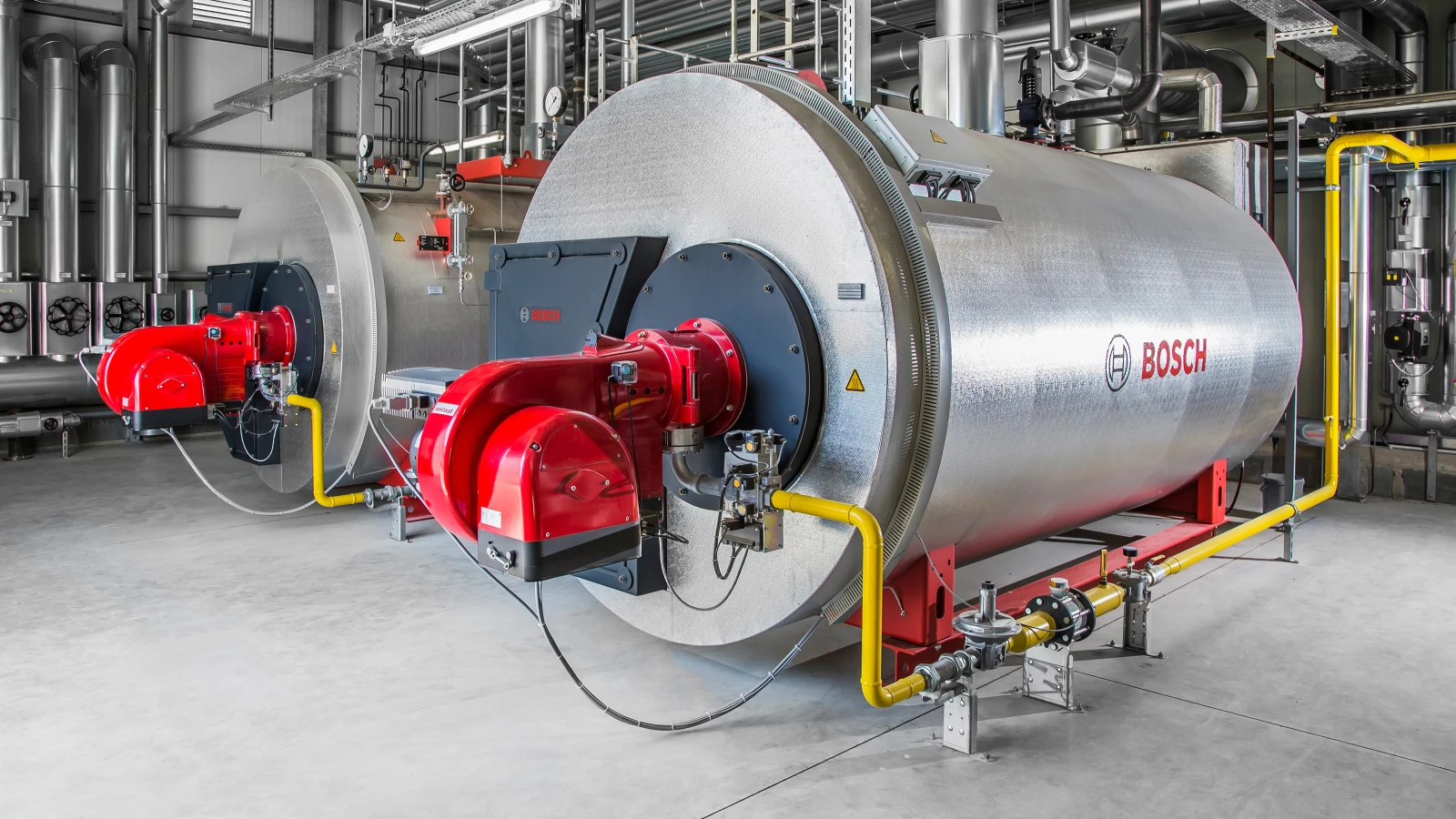
Each of the two new UL-S type steam boilers has a capacity of 5,000 kilograms of steam per hour. The company primarily uses process heat to preserve mushrooms and refine forest fruits and soup ingredients. A boiler is used as a backup and to cover peak loads.

Insights into our technology
Take a look behind the scenes. In this video, we show you our high-quality industrial boilers and system components up close.
Use of waste heat to heat feed water
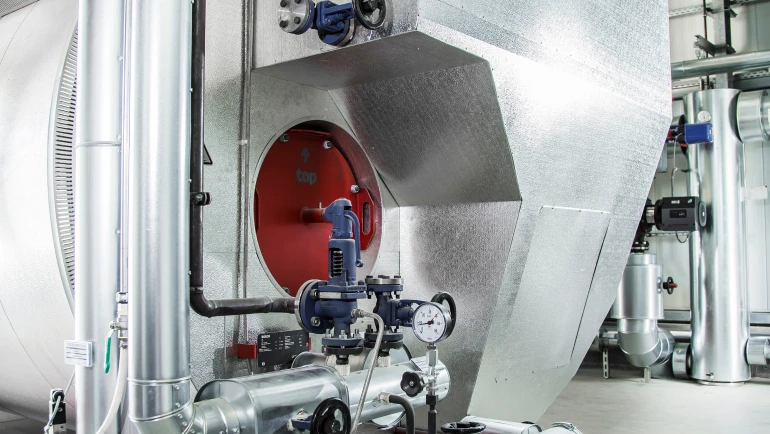
The integrated economizer maximises efficiency.
Integrated economizers maximise energy efficiency. The boiler feed water is fed into the flue gas heat exchanger and preheated to approx. 135 °C with hot flue gases. This process causes the flue gas temperature to drop to approximately the same value at full load. The efficiency of the plant increases by 4.8 per cent and fuel consumption decreases by the same proportion.
Efficiency with modern natural gas burners
Natural gas burners make for very economical operation. The burners' electronic compound control optimises the dosing of fuel and combustion air. In comparison to the mechanical compound control used in the old burners, this achieves a more precise setting and reduces fuel consumption accordingly.
Another advantage comes from modulating operation with a control range of just 1: 6. The burner output is adapted to the actual steam requirement infinitely variably. The burner system can reduce the capacity to up to approx. 17% of the nominal output. The switching frequency of the burners drops significantly. Energy losses caused by upstream ventilation of the flue gas channels are reduced.
Furthermore, the speed of the fan motors is controlled dependent upon the burner capacity, resulting in significantly lower electricity consumption at partial load. Electricity costs and volume are reduced.
Clean feed water for long service life
Boiler feed water that has been treated in the best possible way is vital to the long service life and efficient operation of a boiler. Elements contained in the water (calcium and magnesium, for example) lead to undesirable coatings. As a consequence, boiler efficiency and steam quality deteriorate. In some cases, the plant can even be damaged beyond repair. Softened make-up water is produced in the WTM softening system via an ion exchange process.
This process substitutes the ions causing the hardness (calcium and magnesium) with sodium ions. To reduce susceptibility to corrosion, thermal deaeration is performed after the softening process via the WSM-V water service module. The water is heated to a temperature of approx. 103 °C, causing the gases contained in the water to dissolve and be channelled away. To bind any leftover hardness and oxygen, and to make the boiler water alkaline, chemicals are added to the feed water. After this, the water is fed to the boilers via the feed water pumps and the economizer.
Heat recovery from desalting water
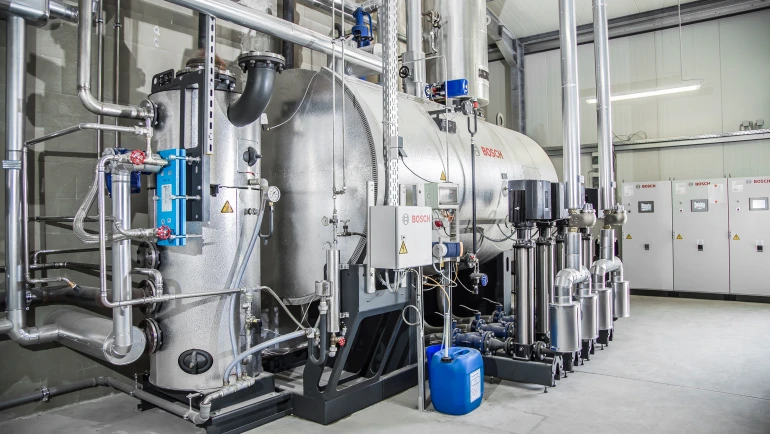
The water service module with heat recovery from the desalting water.
The EHB expansion, heat recovery and blow-down module removes the waste water from the steam boilers (desalting/desludging). The desalting water, which is under pressure and at temperature, is fed into the expansion tank and expanded. The expansion steam produced in this process contributes to heating the feed water. The remaining desalted water is fed to the downstream heat exchanger and used to heat cold make-up water. The temperature of the desalting water falls to approx. 35 °C. The cooled desalting water and the hot desludging water is fed into the blow-down and cooling tank. If necessary, the water is cooled by mixing in cold make-up water at discharge temperature and forwarded on. The module increases the efficiency of the plant and is instrumental in reducing fuel, cooling water and waste water costs.
Less make-up water saves money
In addition, the plant is fitted with a CSM condensate service module. The module collects and stores accumulated condensate and channels it back to the feed water deaeration system via a condensate pump. An integrated monitoring device ensures that no harmful foreign matter can get into the boiler feed water. Feeding back the condensate means that less make-up water is required and the consumption of water and energy is reduced.
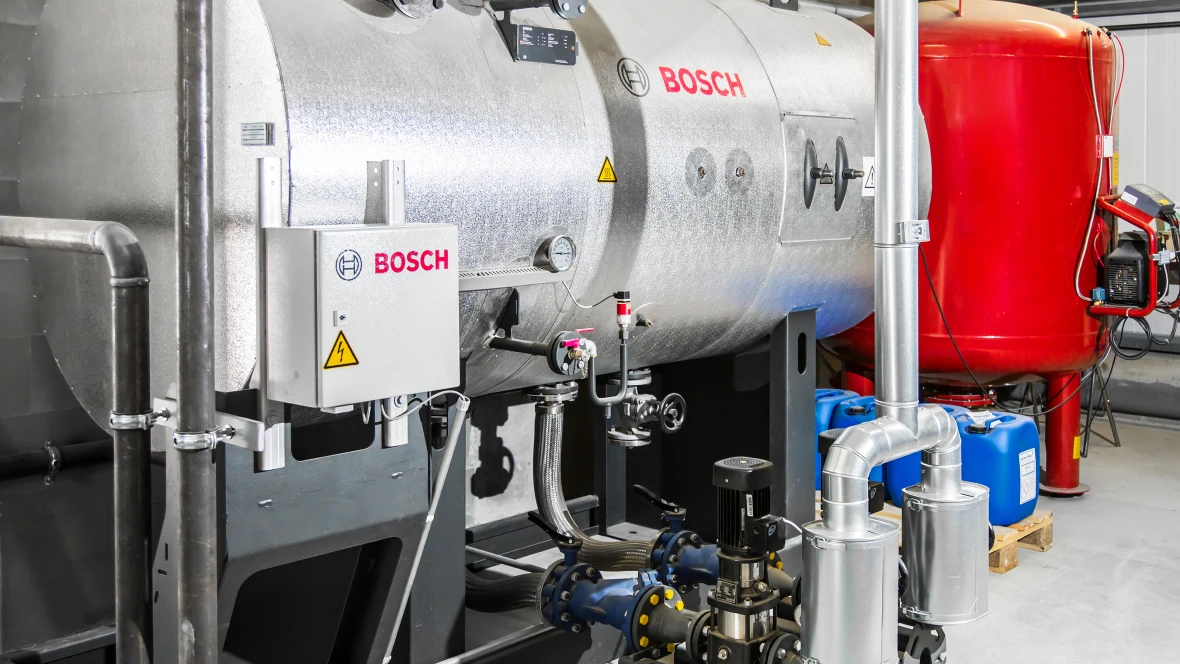
Reduction in make-up water quantities through use of condensate service module.
User-friendly boilers
The intuitive BCO controls make the boilers easy to operate. All data (fuel consumption, steam quantity, pressure history or the number of times the burner is switched on and off, for example) can be called up, analysed and configured for maximum energy efficiency. The SUC start-up, standby and shutdown control is available via the BCO. Triggered by a single push of a button or an external request signal, the start-up and shutdown processes of the steam boiler are completely automated. During normal operation, the integrated automatic functions protect the boiler and the plant from corrosion, water impact and brining. Mechanical load is also reduced, in particular during cold starts. Boiler attendants are relieved of a multitude of tasks, allowing them to focus solely on monitoring and supervisory functions.
Multi-boiler plant operation with consumption optimised
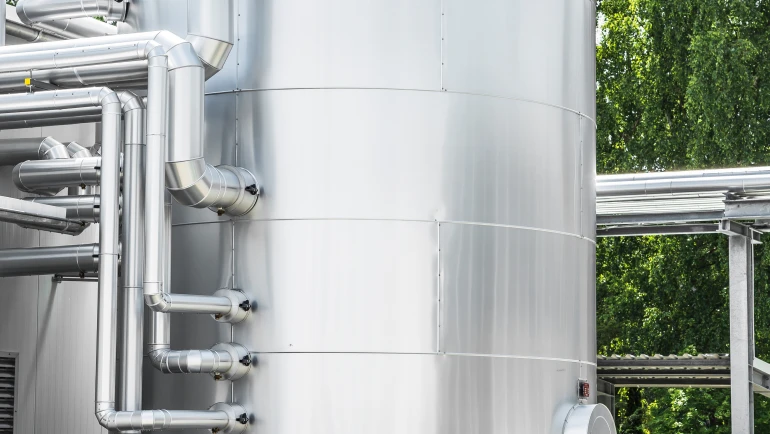
The waste heat from the compressors and cold stores is buffered in the heat storage tank.
The SCO system control combines boiler and module controls in one universal management system. The integrated sequence control applies the consumption-optimised operating mode for the multi-boiler plant. Switchover of primary and follow-in boilers is automated for smooth and economic use of the steam boilers. The sequence control circuit is implemented via system pressure regulation. If the pressure in the system falls below an adjustable value, an ON signal is sent to the follow-in boiler. This is done by opening the motorised valve. If the steam pressure in the system rises again, the motorised steam shut-off valve will close the follow-in boiler. Both boilers are kept warm by means of a heating coil that is built into the boiler end. The follow-in boiler can thus be kept warm by the primary boiler at reduced pressure. This saves energy, avoids corrosion and safeguards rapid availability.
Other measures: Using waste heat to heat process water
In addition to the new boiler system, Valenzi selected further measures to save energy, including waste heat utilisation in the compressors and cold stores. When the compressed air is compressed in the compressors, heat is produced. This energy is channelled to a heat storage tank via plate-type heat exchangers. The waste heat from the compression refrigeration units also goes to the storage tank. The thermal energy is used to heat fresh water for production and cleaning purposes. If the thermal quantity in the storage tank is not sufficient, it is supplemented by steam post-heating.
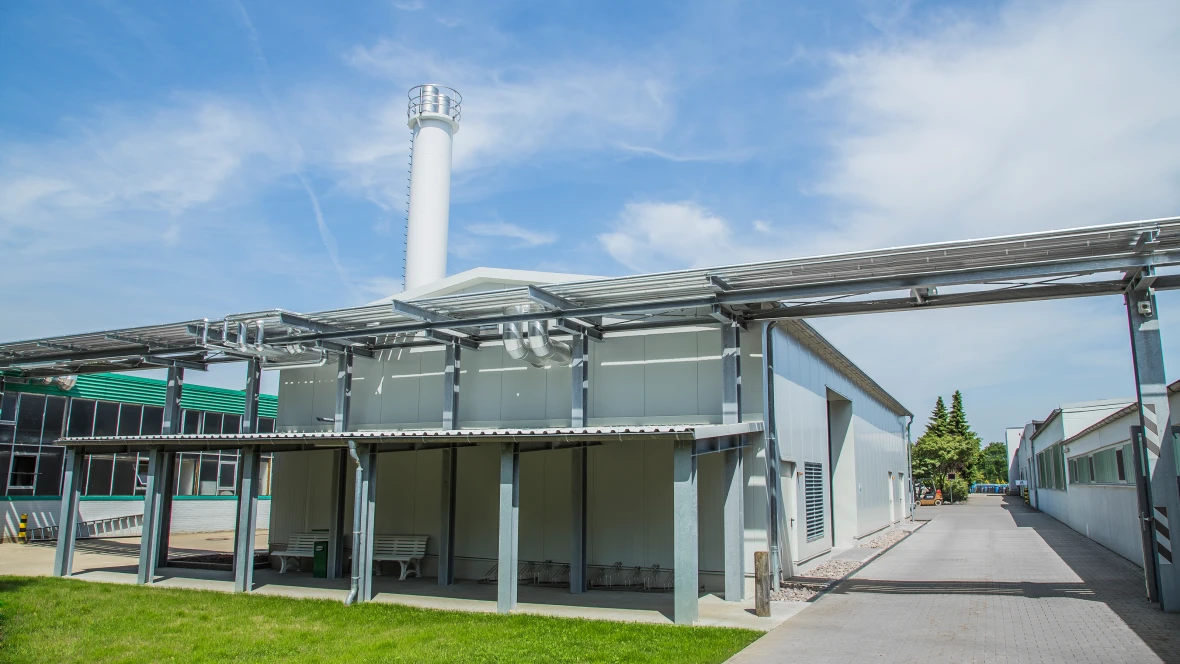
Implementation phases
- Building of a new boiler house
- Use of two steam boilers with integrated economizers and heat maintenance systems
- Use of modern natural gas burners with electronic compound control
- Installation of energy-saving speed regulation
- Installation of modules for heat recovery, water treatment and condensate recirculation
- Integration of programmable controls with automatic start-up and sequence control for energy-optimised operation
- Integration of a heat storage tank so that waste heat from the compressor and refrigeration system can be used in production
The result
Valenzi GmbH & Co.KG anticipates that this investment in new plant technology will result in annual energy savings of around 40,000 euro. It also cuts its CO2 emissions by approximately 300 tons. The modular design of the Bosch boilers and components meant that effort for planning and installation could be kept low. The operator benefits thanks to an increased degree of automation in the energy generation system, which has been optimised from both an economic and ecological perspective.
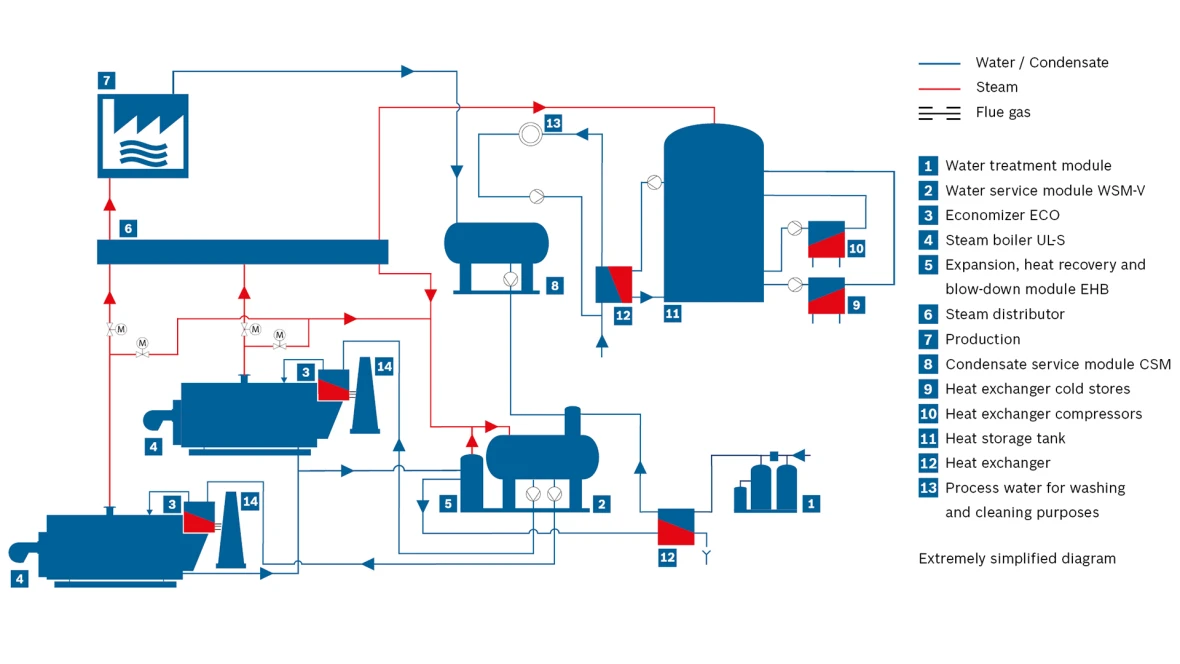
System diagram steam boiler with appropriate plant technology for heat recovery, water treatment and waste heat utilisation involving the compressors and cold stores.