
Efficient steam supply for energy saving windows
Modular boiler system for Beck+Heun
The operator
Beck+Heun GmbH is a leading manufacturer of roller shutter casings and develops pioneering solutions for everything related to windows. The innovative products of this family-owned company increase the energy efficiency of buildings and therefore actively contribute towards climate protection. In addition to the company headquarters in Mengerskirchen in Hesse, Beck+Heun has two branches in Altmünster and Erfurt.
The project
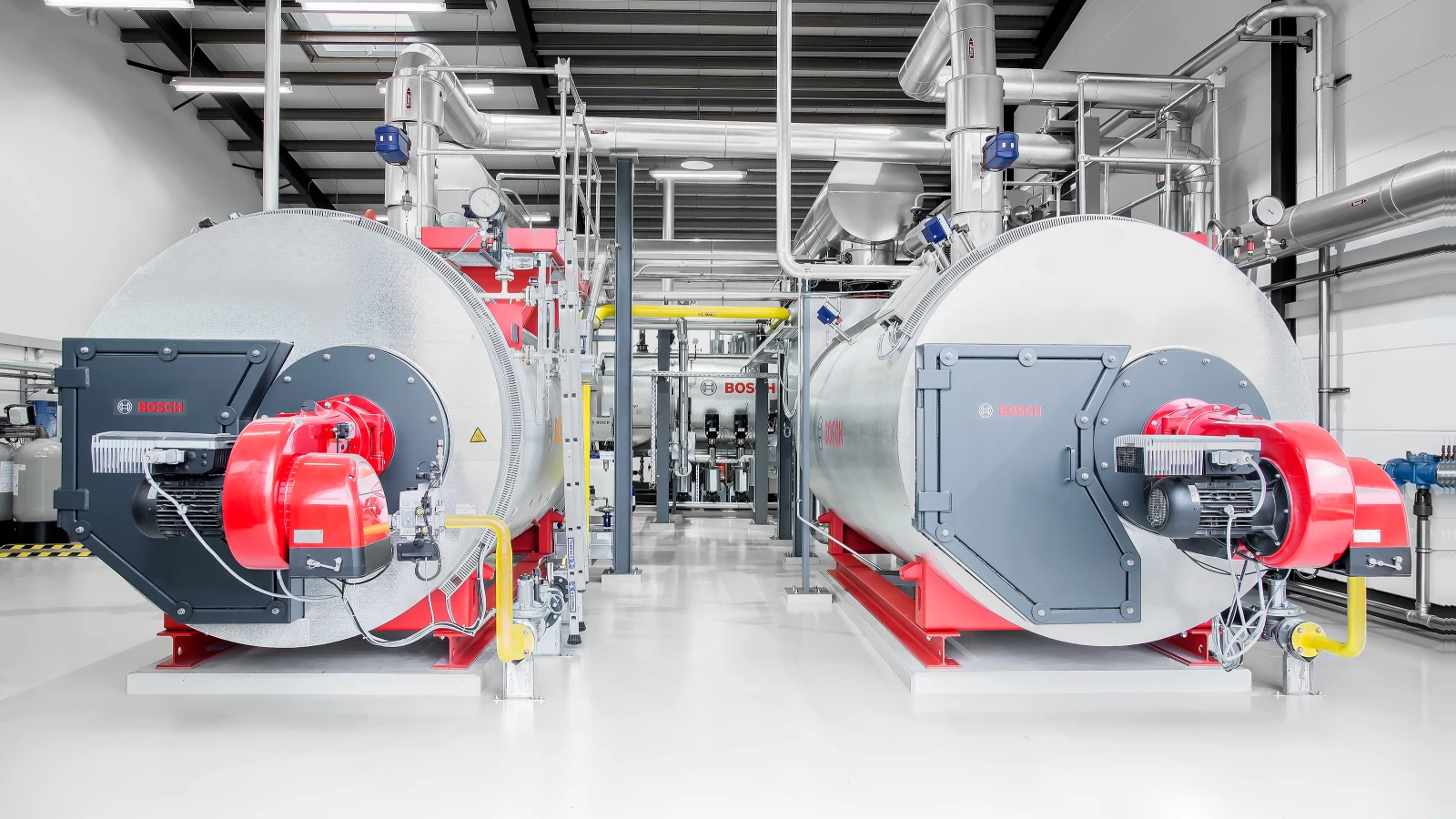
In 2013/2014, Beck+Heun modernised its machine fleet with the objective of increasing production capacities by 25%. The company also wanted to increase the efficiency of their process heat supply in order to make more effective use of resources and reduce energy costs. Bosch Industriekessel has implemented the new steam boiler plant at the Mengerskirchen site in collaboration with the plant construction company Ago AG Energie + Anlagen. Beck+Heun uses steam to pre-expand polystyrene granules which are subsequently used for the fabrication of roller shutter casings. Additional process heat is required due to a further pre-expanding plant. The new energy system comprising two UL-S steam boilers has therefore been designed for a peak load of 8 t of steam per hour. The previous process heat generation comprised three boilers with a total capacity of 5.5 t of steam per hour, with the oldest boiler dating back to the 1970s. The boilers were delivered ready to connect with pre-assembled components. Therefore the installation of the overall plant, carried out by the company Ago, went smoothly. Furthermore, the Bosch Customer Service was able to quickly commission the boiler system thanks to the pre-configured and tested controls. The complete project was realized without interruptions of the production.
In comparison with the previous steam generation, the efficiency of the overall system has improved by around 20%

Insights into our technology
Take a look behind the scenes. In this video, we show you our high-quality industrial boilers and system components up close.
Water quality is crucial
After softening and desalting, thermal deaeration of make-up water is an important process which protects the boilers and components from corrosion and guarantees a long service life of the plant. During this process, make-up water is heated to a temperature of 103 °C using steam. As the temperature increases, corrosive gases (carbon dioxide and oxygen) become less soluble. They leave the system as so-called exhaust vapours which condense in a downstream vapour cooler. The recovered heat is used to heat up the make-up water. This reduces the internal energy consumption of the plant and the necessary amount of fuel per produced ton of steam.
After the deaeration the adaptive control adds the needed amount of corrosion inhibitors in order to bind any residual quantities of carbon dioxide and oxygen. Bosch supplied a pre-assembled module with trickle deaeration device, feed water tank, chemical metering system and controller for the entire thermal water treatment process.
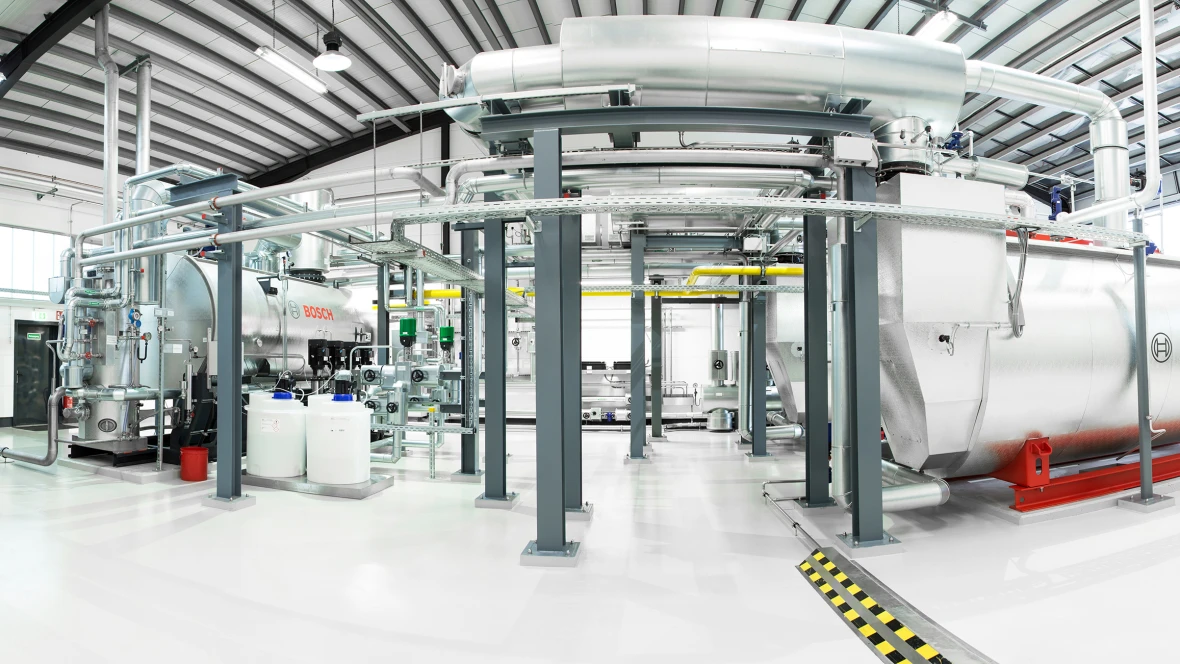
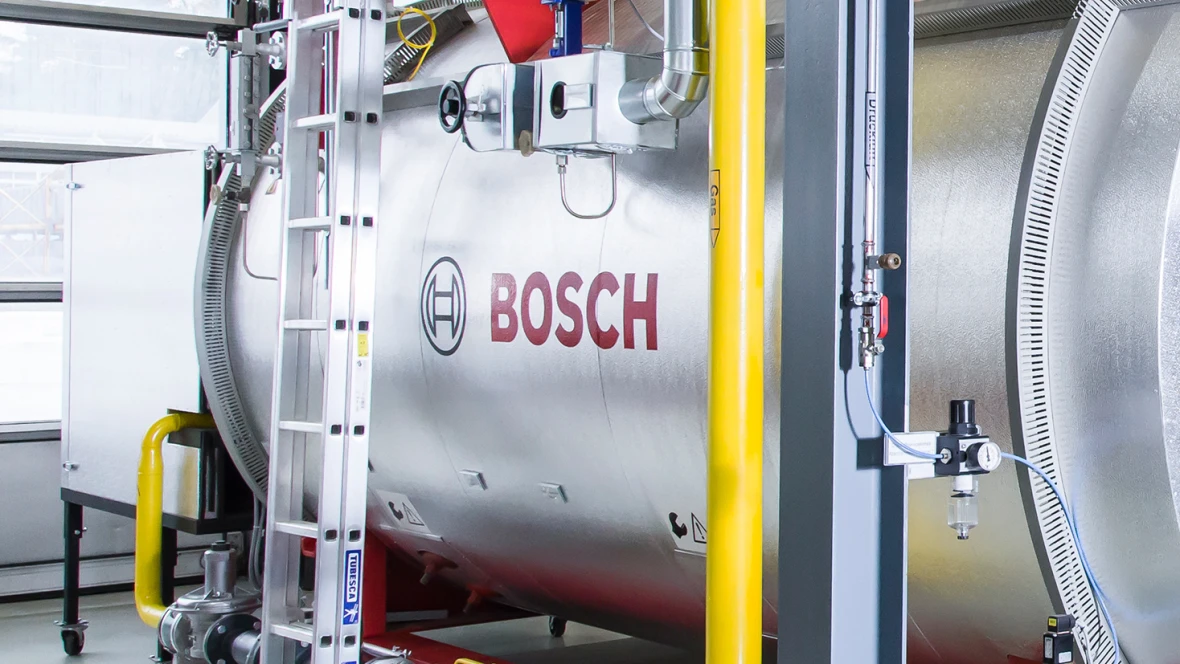
Water service module for deaeration (left) and the two UL-S steam boilers.
Automation saves energy and time
When steam is generated, salts accumulate in the boiler water. For safety reasons, some of the water containing salt and sludge at the boiler end is regularly discharged. However, this waste water contains significant amounts of energy. The salt concentration in the boiler water is monitored automatically with conductivity electrodes. The demand-controlled blow-down and desalting reduce energy losses and demand for make-up water. Further benefits are the reduced risk of operating errors and reduced obligation to supervise. Further, a pressure reducer and heat exchanger was installed to recover most of the energy in the desalting water. During the first step, the hot boiler water solution is expanded which produces expansion steam that supports the supply of heat to the feed water tank. During the second step, the remaining residual heat is also used to preheat the make-up water.
Ingeniously controlled and energy-efficient
The new natural gas firing systems with speed-controlled burner fans consume much less power. They ensure that the fan does not run at full speed in partial load ranges by adapting to the actual output of the boiler. Additional benefits are quiet operation and increased service life of the fan.
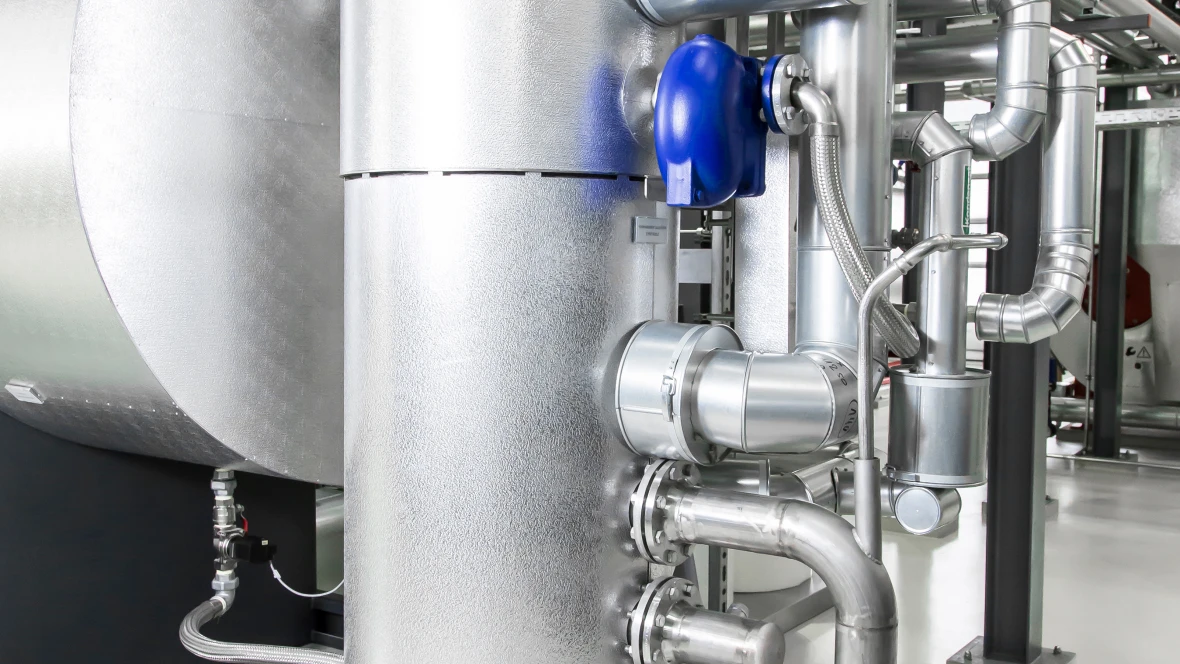
Heat recovery from desalting water.
Adaptive combustion control
During commissioning, the plant is adjusted optimally to the current gas quality, air temperature, and ambient air. During operation of the boilers over the years these factors change and would affect the efficiency negatively. The adaptive combustion control provides a solution: Deviations from the optimum can be corrected using an oxygen measuring probe in the exhaust gas section. This reduces fuel consumption and also the stress on the boiler.
Use waste heat to save fuel
The boilers are equipped with integrated economizers so that the valuable waste heat from the boiler flue gases can be used to preheat the feed water. During this process, the flue gas temperature is reduced to around 120 °C while at the same time the temperature of the feed water increases to roughly 140 °C. This means that it must be heated up less by the burner resulting in fuel savings of up to 6%.
Stainless steel heat exchangers are connected downstream of the economizers in order to further utilise the enthalpy in the flue gases. The additional temperature reduction causes the water vapour in the flue gas to condense. The condensation heat released is used to heat up the make-up water which saves fuel during the thermal water treatment (deaeration). Thanks to condensing technology, a boiler efficiency of more than 100% (regarding the caloric value of the gas) can be achieved.
+20%
Eco-friendly by saving resources: Supply of process heat with waste heat recovery.
Operating data at a glance
The programmable boiler controls make it easier to optimize the plant settings and ensure an energy-efficient boiler operation. They provide the operator with all information, such as fuel consumption, steam quantity or number of burner starts. Integrated safety features prevent incorrect operation and ensure a high reliability of the steam plant. The remote connection provides additional support: If required a Bosch service engineer can analyze and optimize plant settings remotely.
All the boiler and module controls are combined within the system control SCO. Their integrated sequence control ensures economical operation of the boilers, also with a heavily-fluctuating demand for steam. To ensure fast availability and minimise cold start losses, both steam boilers are equipped with a heat retention device via the burner system.
Further, the boilers and system modules are connected to the building automation system of Beck+Heun. The latest operating messages and process data of the boiler system are transmitted via the link to the company's process control centre.
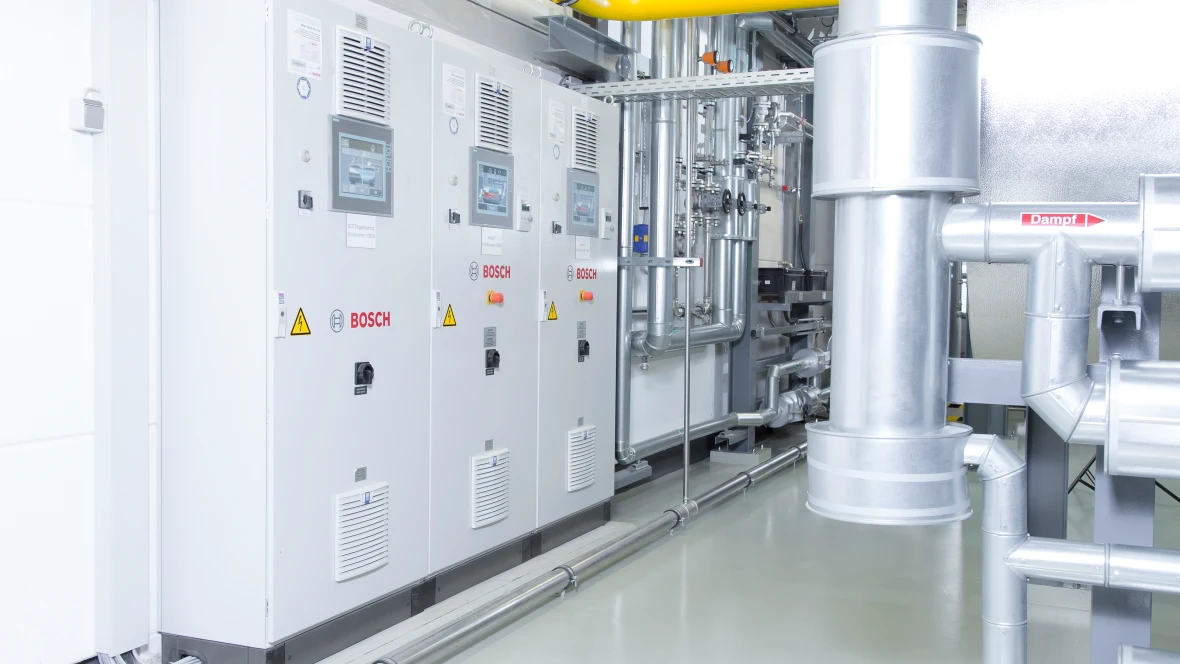
BCO/SCO boiler and system control.
Implementation phases
- Refurbishment of an existing hall to create boiler house
- Delivery of new steam boiler plant
- Assembly and installation of new boilers and boiler house components
- Integration of new control technology
- Commissioning during production, switching over from exisiting to new plant without interruption
- Dismantling and removal of existing plant
The result
The collaboration between Bosch Industriekessel and the plant construction company Ago made it possible to implement the energy concept at Beck+Heun quickly and reliably. The new boiler system not only produces 45% more steam, it is also around 20% more efficient than the previous plant. The fuel requirement has reduced by nearly 1 900 MWh per year. Furthermore, the CO2 emissions have been reduced significantly. The regular maintenance provided by Bosch Customer Service ensures high reliability of the plant, low-energy consumption and a longer service life.
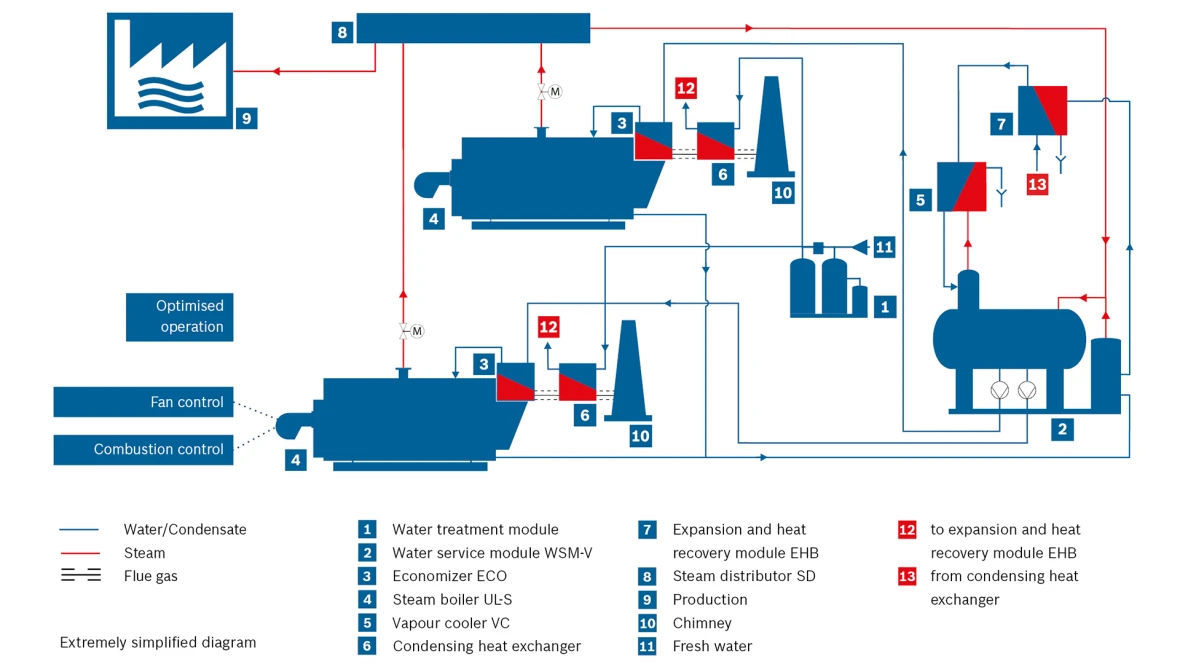
Simplified piping scheme of the plant.