
Energy-saving pump factory
KSB changes over to hot water operation
The company
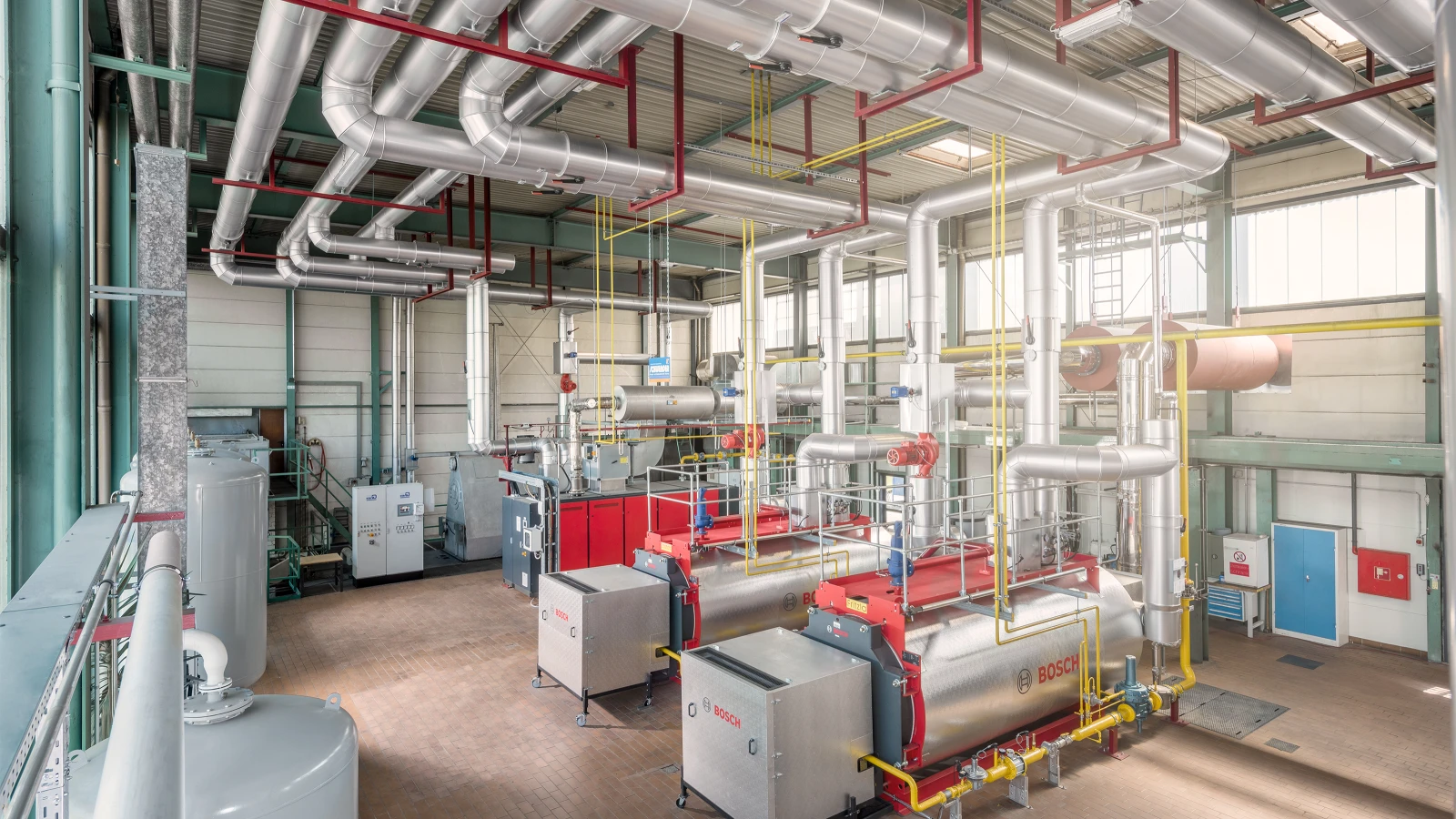
The pumps from KSB transport heat, water, gas and many other media reliably, safely and efficiently. The company's innovative pump technology is used almost everywhere – whether it is in power stations, in industry or in mining and of course in KSB's own central heating plant at its Pegnitz site (Germany). In order to reduce its energy consumption, the company made the decision to change over completely from steam operation to hot water operation involving the installation of two new Bosch heating boilers type UT-L. In addition to this, the new energy concept includes a CHP unit from Bosch, while an existing Loos solid fuel boiler also supports the heating network. The system technology is perfectly complemented by the company's own KSB pumps, which assist in transporting the heat from A to B. The engineering consultants, Ingenieurbüro Karl Müller from Bayreuth, were entrusted with the overall planning and supervision of the project, while the plant construction company, Schwender Energie- und Gebäudetechnik from Thurnau, was responsible for implementing the conversion work, including the dismantling of the old system and the installation of the new one.
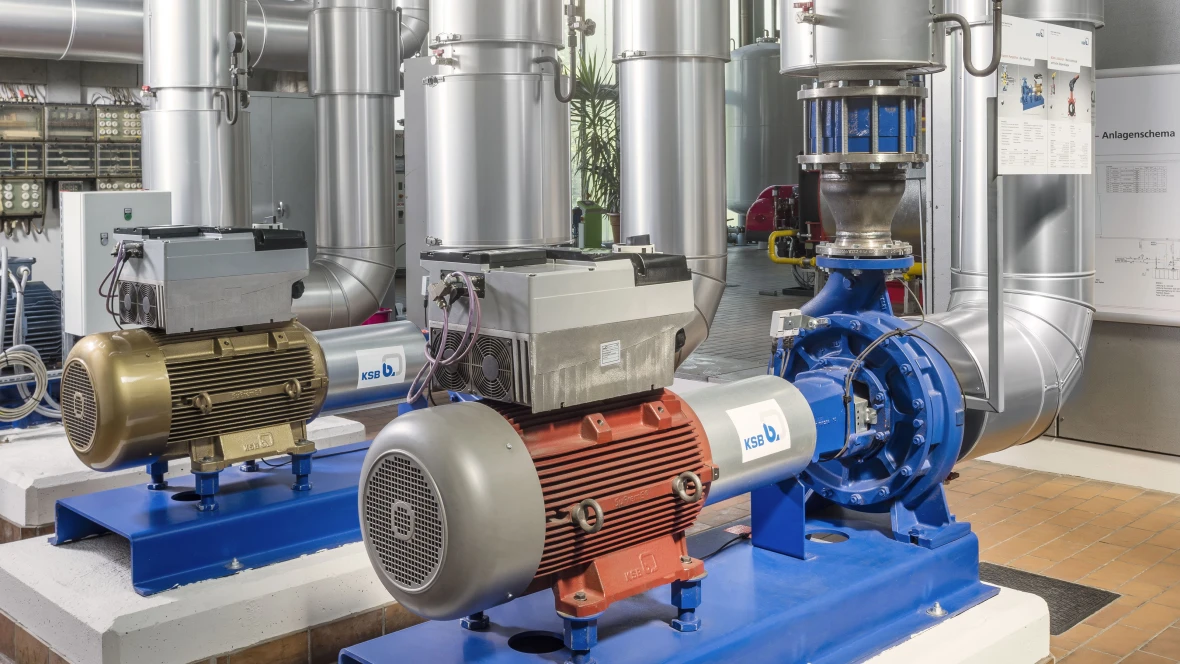
Efficient pump technology by KSB used in its own central heating plant.
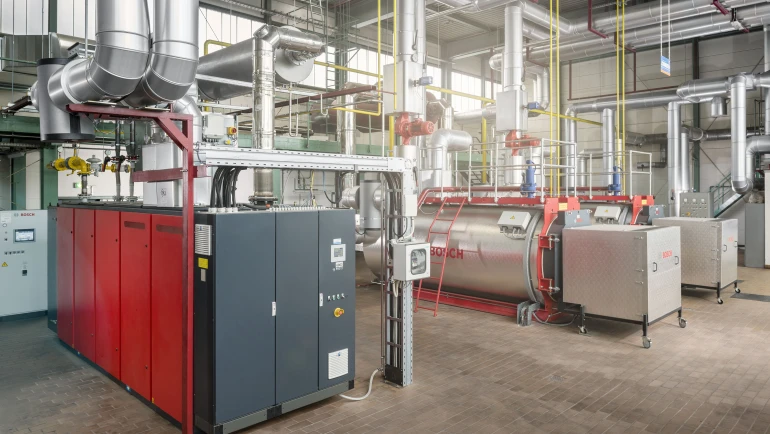
The Bosch CHP provides the base load for heating and at the same time electric power for the company’s own consumption.
CHP unit generates the heat base load – and power for own use
As in every industrial operation, electric power consumption at KSB involves significant costs. The new CHP unit from Bosch helps to reduce part of the power requirement, for example for lighting, power operated systems and different processes: some 400 kW of electricity is available from this source – so around 12 % of the total power demand is covered by generating own low-cost electricity. The gas-powered CHP unit with a thermal output of 500 kW also generates the heat base load for heating the building and for hot water. In order to achieve the longest possible operating times, a buffer tank with 50 m³ water capacity was set up next to the central heating plant.
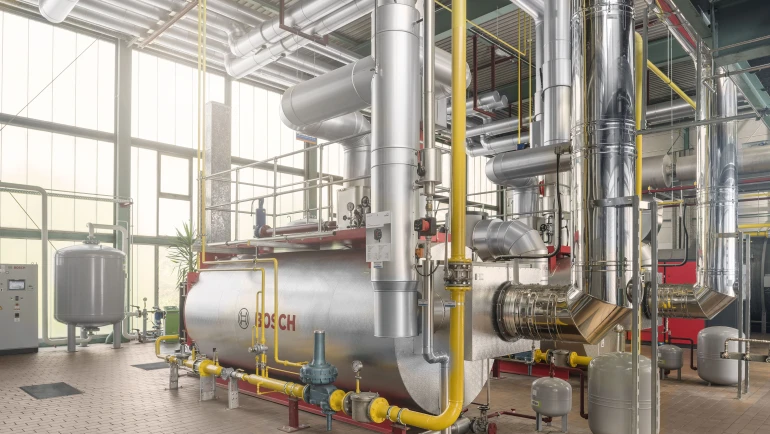
The Bosch UT-L heating boilers perfectly complement the heating network and convince through their high efficiency.
Heating boilers covers flexible heat demand
Most of the heat at KSB was originally generated by two steam boilers manufactured in 1974, each with an output of 9.3 MW. These large boilers generated steam at temperatures of 187 °C. The steam was converted to hot water by a downstream converter. An analysis showed, that significant energy savings could be achieved by replacing the old boilers and changing over to hot water operation. The maximum temperature requirements of the consumers are 100 °C and can easily be met by a hot water heating system. The existing system had also in the meantime become considerably oversized for the actual energy needs: continual efficiency measures and modernization at the Pegnitz site had reduced the heat demand over the years. While the total heat output of the steam boilers was 18.6 MW, the new boilers now have a total output of 8.4 MW. One of these is primarily used as a backup and, due to its dual-fuel firing, can be operated with gas as well as oil. Thanks to the high control range of the burners, the heating boilers are able to respond flexibly to the heat demands. Sudden switching on and off and the associated energy loss can therefore be prevented.
Further, both boilers are fitted with integrated flue gas heat exchangers. They use the hot boiler flue gases to heat the return flow water – hence the fuel demand for generating heat is reduced and an high efficiency level of almost 97 % is reached. The boilers are also characterized by their compact design and enabled them to be transported easily through the door of the central heating plant. Due to their small footprint there was enough space in the building for setting up the CHP unit.
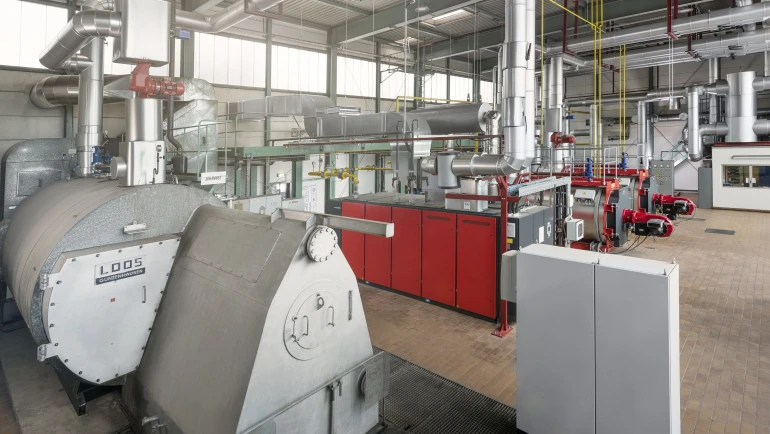
In operation since decades: The modernized Loos solid fuel boiler supports the heating supply.
A piece of history remains in the central heating plant
Since 1972 KSB has operated a Loos solid fuel boiler. Up to the time of the refurbishment of the central heating plant, this boiler burnt various types of waste wood such as damaged pallets, and it generated steam using this fuel. As the wood-fired boiler was in good condition, KSB decided to retrofit the boiler from steam to hot water operation and continue to keep a piece of history running. Bosch Industriekessel delivered the necessary equipment, boiler sensors and boiler control system. With an output of 2.1 MW, the boiler supports the heating network, primarily during the winter months. Excess thermal heat is stored in the buffer tank, where it is available for later peaks in demand.
The result
In addition to the reduced energy costs due to decentralized electric power generation, the measures result in an annual fuel saving of approx. 1 GWh of natural gas. Among other things, this leads to 2,000 t less CO2 emissions per year. Operation reliability and automation in generating and distributing heat have also improved significantly. All factors – especially the well thought-out planning work of the engineering consultants Karl Müller to the perfect installation work by Schwender – contributed to the successful implementation of the project.
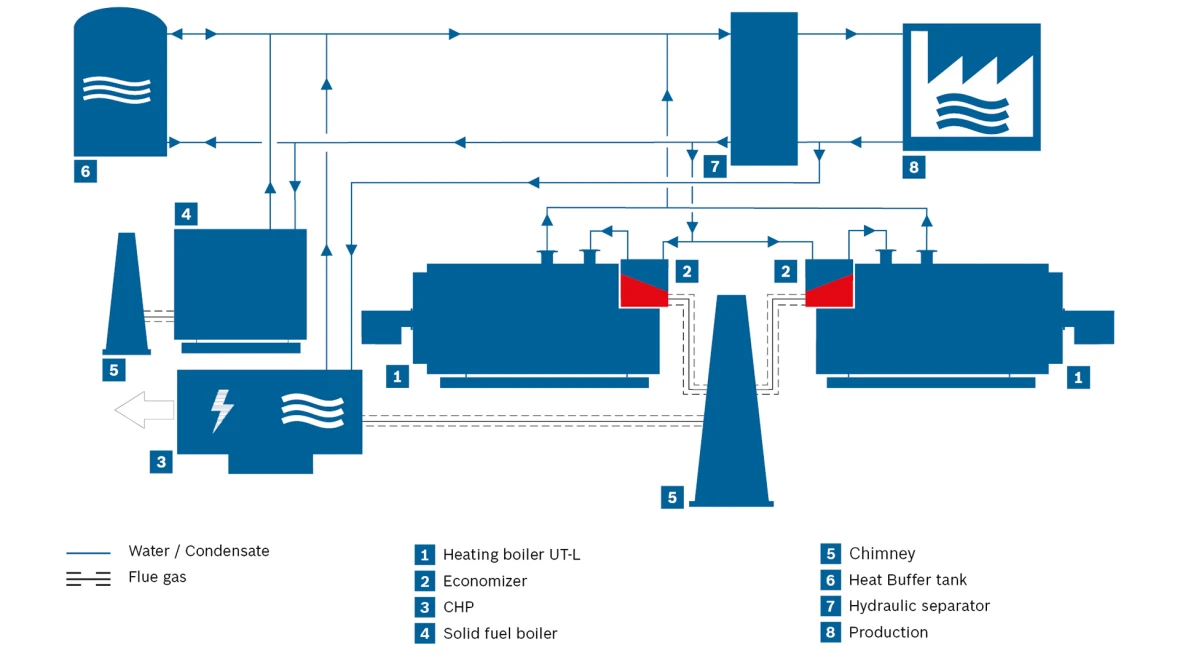
Simplified piping and instrumentation diagram of the plant