
Efficient process heat for herbal medicines
Multi-storey boiler house in the pharmaceutical industry
The company
Bionorica SE is a company operating worldwide in the herbal medicine sector with more than 1,500 employees. Bionorica attributes its success, which has been growing for many years in Germany and in over 50 international pharmaceutical markets, to its unique research and manufacturing philosophy. The complex technique called "Phytoneering" includes scientific research, which is carried out worldwide at great expense and effort: this comprises the development of the company's own range of medicinal plants as well as patented manufacturing methods and recognized clinical studies of the effectiveness and safety of the herbal preparations. Bionorica produces virtually all its products on the 42,000 m² site at its headquarters in Neumarkt in der Oberpfalz (Germany). As a manufacturer of herbal medicines, it is essential that it acts sustainably throughout all its processes. This means of course, that the new system for supplying process steam had to satisfy all the ecological and efficiency aspects.
The project
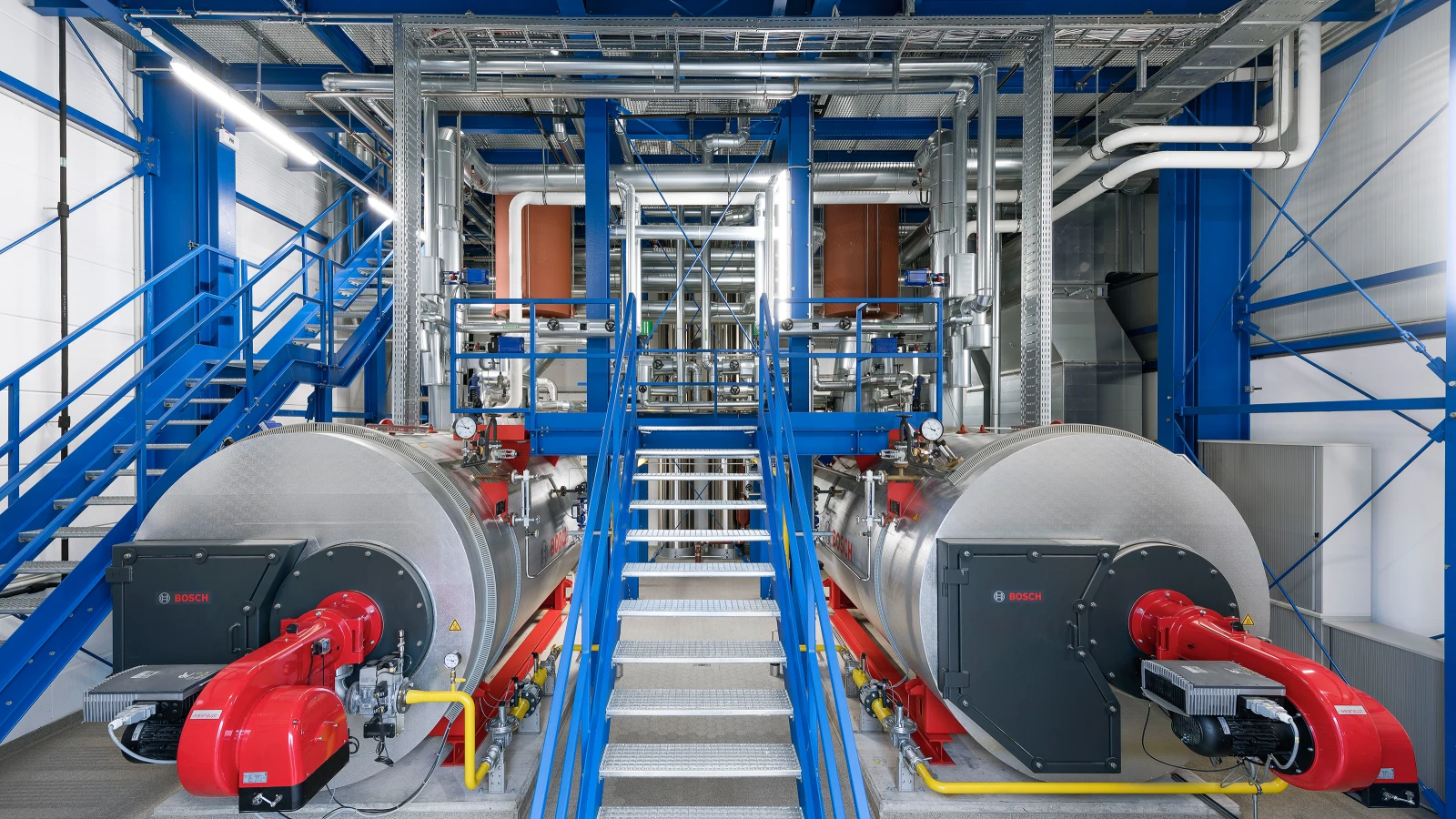
Bionorica's rapid growth in recent years, along with new production lines, has created an enormous increase in the process heat demand. Numerous processes involved in the manufacture of herbal medicines require process heat in the form of steam. Particularly energy-intensive are, for example, the extraction of the herbal raw materials, their concentration and drying as well as the preparation of cleaning agents. The existing plant from 1993 with its total steam capacity of 4 t/h was no longer able to meet the rising demand. The engineering consultants, Farmbauer, planned the completely new steam supply system with due consideration of the company's environmental philosophy. A major challenge was the realization of the new boiler house. Due to the building situation at the Neumarkt site, the amount of floor area available for construction was very limited. However, there was plenty of space upwards, and so Petry AG, the plant construction company responsible for the project, installed the modules for water treatment and the downstream flue gas heat exchangers on a second level, directly below the boiler house roof. The two UL-S steam boilers were sited on the ground floor. They deliver a total of up to 10 tons of steam per hour in a highly efficient and resource-saving way - very much in the spirit of Bionorica.
Using waste heat efficiently
In order to get the most out of the flue gas waste heat produced by steam generation, and hence keep fuel consumption and emissions as low as possible, it was decided that two flue gas heat exchangers per boiler would be used. These two components alone save over 800,000 euros in natural gas costs over the course of 10 years. This means that the environment is spared through a saving of 4,800 tons of CO2 emissions, which equates to the emissions of more than 2,400 passenger cars. First, the hot flue gas flows through the integrated economizer to preheat the feed water, which means that less fuel is needed to generate the steam. Due to the continuously high demand for hot process water for the leaching/acid station during production, it also made sense to integrate condensing heat exchangers. The flue gas is cooled down further in these. The energy recovered in the process increases the temperature of the process water out of the mains line from 10 °C to approx. 55 °C. The investment in the condensing heat exchangers will have been amortized in just about two years. Additionally, the boilers are equipped with combustion control systems to further enhance their efficiency and reduce flue gas losses. These work in a similar way to the Lambda control in a passenger car.
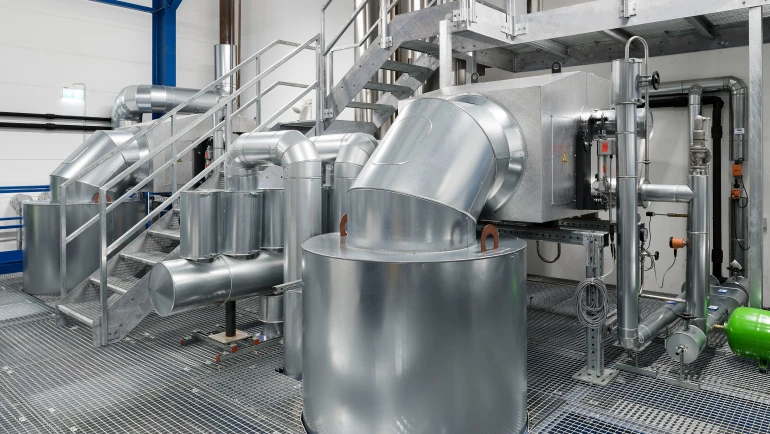
Condensing heat exchangers: Preheat process water cost-effectively with condensation heat.
It is not just flue gas heat from the steam boilers that can be recovered, but also process-related waste heat from thermal deaeration. An installed vapour cooler condenses the so-called exhaust vapour. The recovered energy is used to preheat the make-up water, before it reaches the feed water tank. This again saves heating energy and therefore fuel costs in the deaeration process described below.
Optimum water quality
All water is not the same. Fresh water must first be treated and thermally deaerated, before it can be used to generate steam. Thermal deaeration is installed downstream of water softening to remove harmful, corrosive components such as carbon dioxide and oxygen. The WSM water service module for full deaeration used was pre-assembled in the Bosch factory, consisting of a feed water tank, controls and dosing system. The system takes make-up water and condensate from the process and heats it to 103 °C. As the temperature increases, the dissolved gases escape through the roof together with the exhaust vapour. The gas-free feed water is routed via the economizer to the boiler by means of speed-controlled pumps.
A further significant saving is achieved by condensate recovery. The condensate module allows accumulating condensate from the consumers to be recovered, which reduces the need for make-up water enormously. The module collects, saves and conveys it as required to the full deaeration system. Since the condensate is already at a higher temperature, the energy consumption within the thermal deaeration process is reduced even further.
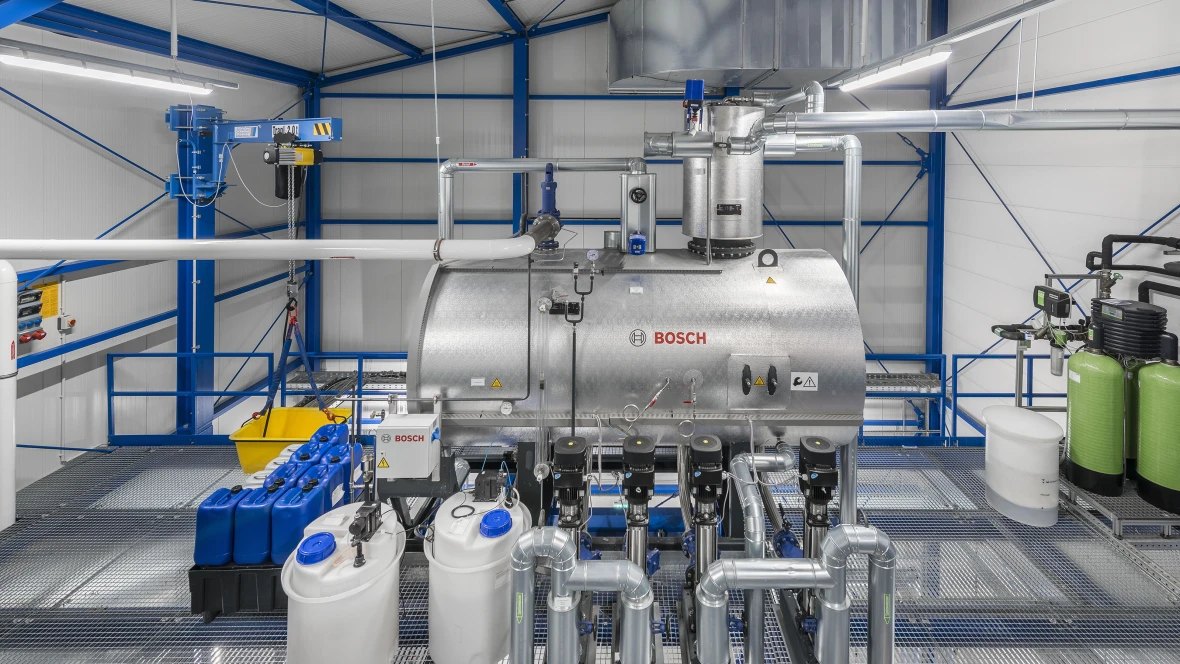
The WSM water service module is installed on the second level of the boiler house and provides the boilers with thermally treated feed water.
Quiet operation
Bionorica takes great care in ensuring low-noise operation - for the well-being of its employees and neighbors. The speed-controlled combustion air fans of the natural gas burners achieve a major effect here. They adjust the speed to the actual boiler load, thereby considerably reducing the sound emission from the air damper and fan. In addition to this, the electricity bill is significantly lower, as a speed control leads to a saving of up to 70% in electrical energy in partial load. The sound-absorbing burner hoods reduce the burner noise as well. The natural combustion noises, which resonate through the flue gas system and chimney, are also minimized thanks to the flue gas silencers installed. The sound pressure level drops up to 21 dB(A) - just as a comparison: a reduction of only 10 dB equates to halving the perceived sound volume.
Automatic operation – with a view to efficiency and operating behaviour
The PLC-based BCO and SCO controls at Bionorica enable both boilers and the entire system to be controlled and monitored very conveniently. The BCO boiler controls analyze and save all the operating values. Intelligent functions help the operators at Bionorica to run the boilers at a constantly high level of efficiency. If for example, the desalting values are too high or contamination arises on the flue gas side, this is visualized via the condition monitoring system. Further, the integrated automatic start-up makes it easier to start the boiler from the cold condition, and all the operating processes, such as for example the gradual opening of the steam extraction valve, are performed automatically. This prevents operating errors and helps to preserve the boilers.
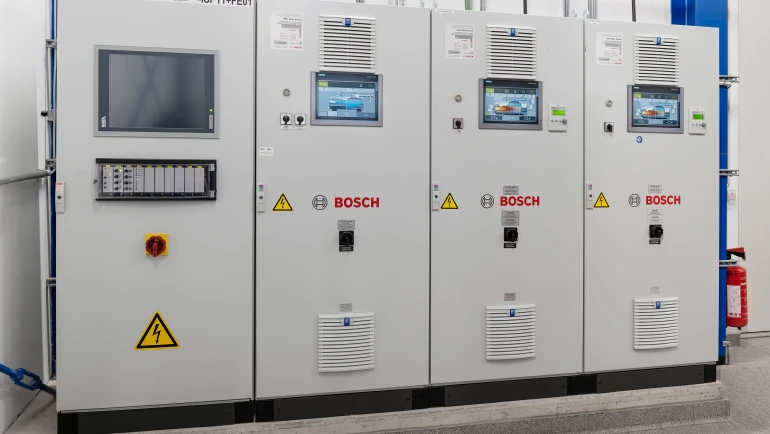
Ready-to-connect control technology from Bosch with intelligent functions optimizes operation and efficiency.
The heart of the control devices is the SCO system control. It combines all the boiler and module controls and transmits data to Bionorica's central control system via a modbus link. The SCO is able to control the full deaeration system, the condensate module, the condensate and conductivity monitoring systems and the boilers themselves. Thanks to the integrated sequence control, both steam generators can be operated particularly efficiently, and even highly fluctuating steam demand can be met without loss of efficiency. As soon as the master boiler can no longer generate the required steam pressure, the slave boiler switches in automatically. Both boilers are kept warm by means of a heating coil, which ensures a particularly rapid availability.
The result
It took barely five months to complete the construction of the boiler house and the entire steam boiler system. The existing boilers provided the production with process heat during the building phase, so that operation could continue uninterrupted. Boasting an extremely high efficiency level of almost 103 % based on calorific value, the new steam boilers are highly impressive in their efficiency and conserve resources sustainably. The heat recovery measures help to reduce consumption and CO2 emissions. And what's more, Bionorica benefits from an improved operating mode thanks to the high degree of automation. All the processes from desalting through to condensate technology and right up to the adaptive change of master and slave boilers are performed automatically.